
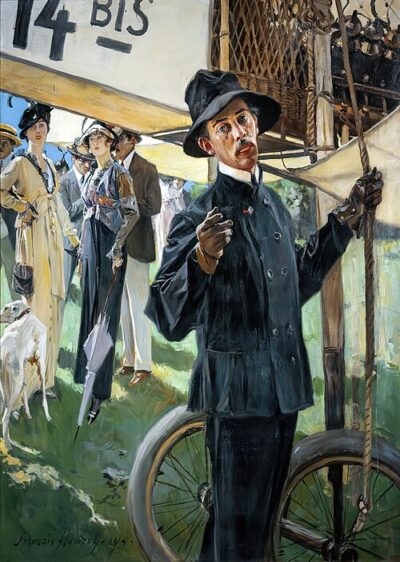
Alberto Santos-Dumont
Alberto Santos-Dumont was a Brazilian aviation pioneer. Born July 20, 1873, in Santos Dumont. Died July 23, 1932, in Guarujá. Educated at Colégio Culto à Ciência. Awards include Commander of the Legion of Honour, Order of Cultural Merit (Brazil) and Grande médaille de l'Aéro-Club de France.
Facts
23 facts · 2 confirmed by two sources · 5 cited · 16 from one source
Where this comes from
Papalocal keeps its own record. It started from these sources; what each one said is kept here as it was copied, so a change on their side never changes this page by itself. Tap one to read its version.
What Wikidata says · copied November 16, 2026 · revision 2568486178
- Described as
- Brazilian aviation pioneer (1873-1932)
- Other names
- Alberto Santos Dumont, Santos-Dumont
- Born
- July 20, 1873 · 8 references
- Died
- July 23, 1932 · 10 references
- Born in
- Santos Dumont
- Died in
- Guarujá · 1 reference
- Buried in
- Cemitério de São João Batista
- Cause of death
- hanging to death
- Citizen of
- Brazil; France
- Occupation
- aircraft pilot · 1 reference; balloonist; scientist · 1 reference; inventor · 1 reference
- Education
- Colégio Culto à Ciência
- Member of
- Brazilian Academy of Letters
- Awards
- Commander of the Legion of Honour; Order of Cultural Merit (Brazil) (2006); Grande médaille de l'Aéro-Club de France; Order of Merit (1922) · 1 reference; Grand Officer of the Legion of Honour · 1 reference; Livro dos Heróis e Heroínas da Pátria · 1 reference
- Father
- Henrique Dumont
- Mother
- Francisca de Paula Santos
- Siblings
- Luiz Dumont
- Wikipedias with a page
- 57
Wikidata item Q313211 (wikidata.org/wiki/Q313211), public domain (CC0). Copied November 16, 2026.
What Wikipedia says · copied November 16, 2026 · revision 1384625979
Alberto Santos-Dumont (self-stylised as Alberto Santos=Dumont; (20 July 1873 – 23 July 1932) was a Brazilian aeronaut, sportsman, inventor, and one of the few people to have contributed significantly to the early development of both lighter-than-air and heavier-than-air aircraft. The heir of a wealthy family of coffee producers, he dedicated himself to aeronautical study and experimentation in Paris, where he spent most of his adult life. He designed, built, and flew the first powered airships and won the Deutsch prize in 1901, when he flew around the Eiffel Tower in his airship No. 6, becoming one of the most famous people in the world in the early 20th century.
Santos-Dumont then progressed to powered heavier-than-air machines and on 23 October 1906 flew about 60 metres at a height of two to three metres with the fixed-wing 14-bis (also dubbed the Oiseau de proie—"bird of prey") at the Bagatelle Gamefield in Paris, taking off unassisted by an external launch system. On 12 November in front of a crowd, he flew 220 metres at a height of six metres. These were the first heavier-than-air flights certified by the Aeroclub of France, the first such flights officially witnessed by an aeronautics recordkeeping body, and the first of their kind recognised by the Fédération Aéronautique Internationale.
Santos-Dumont is a national hero in Brazil, where it is popularly held that he preceded the Wright brothers in demonstrating a practical aeroplane. Numerous roads, plazas, schools, monuments, and airports there are dedicated to him, and his name is inscribed on the Tancredo Neves Pantheon of the Fatherland and Freedom.
He was a member of the Brazilian Academy of Letters from 1931 until his suicide in 1932.
- Born, in its opening lines
- July 20, 1873
- Died, in its opening lines
- July 23, 1932
From the Wikipedia article “Alberto Santos-Dumont” (en.wikipedia.org/wiki/Alberto_Santos-Dumont), by its contributors, under CC BY-SA 4.0 (creativecommons.org/licenses/by-sa/4.0/). Copied November 16, 2026; not changed.
Confirmed Two sources agree. Cited One source, and it names where it got it. One source One source, without a reference of its own. Sources disagree The sources disagree. We show the best-supported value and keep theirs below.
