
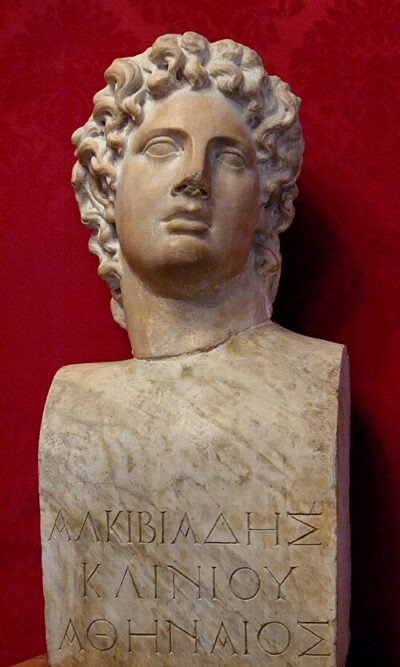
Alcibiades
Alcibiades was an Athenian statesman. Born 450 BC, in Classical Athens. Died 404 BC, in Phrygia. Positions held include strategos (3 times) (-419–-405). Awards include Olympic victor, tethrippon (4-horse chariot).
Facts
19 facts · 0 confirmed by two sources · 7 cited · 10 from one source · 2 where the sources disagree
What’s different
- Born: we show 450 BC (Sources disagree). Wikipedia says 450
- Died: we show 404 BC (Sources disagree). Wikipedia says 404
Where this comes from
Papalocal keeps its own record. It started from these sources; what each one said is kept here as it was copied, so a change on their side never changes this page by itself. Tap one to read its version.
What Wikidata says · copied November 16, 2026 · revision 2568730316
- Described as
- Athenian statesman
- Born
- 450 BC · 2 references
- Died
- 404 BC · 1 reference
- Born in
- Classical Athens · 1 reference
- Died in
- Phrygia
- Cause of death
- stabbing
- Citizen of
- Classical Athens
- Occupation
- politician · 1 reference; military personnel; army officer; military leader · 1 reference
- Positions held
- strategos (3 times) (-419–-405)
- Awards
- Olympic victor, tethrippon (4-horse chariot) (-416) · 1 reference
- Spouse
- Hipparete · 3 references
- Children
- Alcibiades the Younger; Leotychidas
- Father
- Cleinias · 2 references
- Mother
- Deinomache · 2 references
- Siblings
- Cleinias
- Military rank
- strategos · 1 reference
- Wikipedias with a page
- 74
Wikidata item Q187982 (wikidata.org/wiki/Q187982), public domain (CC0). Copied November 16, 2026.
What Wikipedia says · copied November 16, 2026 · revision 1385545074
Alcibiades (; Ancient Greek: Ἀλκιβιάδης; c. 450 – 404 BC) was an Athenian statesman and general. The last of the Alcmaeonidae, he played a major role in the second half of the Peloponnesian War as a strategic advisor, military commander, and politician, but subsequently fell from prominence.
During the course of the Peloponnesian War, Alcibiades changed his political allegiance several times. In his native Athens in the early 410s BC, he advocated an aggressive foreign policy and was a prominent proponent of the Sicilian Expedition. After his political enemies brought charges of sacrilege against him, he fled to Sparta, where he served as a strategic advisor, proposing or supervising several major campaigns against Athens. However, Alcibiades made powerful enemies in Sparta too, and defected to Persia. There he served as an adviser to the satrap Tissaphernes until Athenian political allies brought about his recall. He served as an Athenian general (strategos) for several years, but enemies eventually succeeded in exiling him a second time. He took refuge in Persian territory and was eventually assassinated, reportedly at the instigation of Lysander of Sparta.
Scholars have argued that had the Sicilian expedition been under Alcibiades's command instead of that of Nicias, the expedition might not have met its eventual disastrous fate. In the years when he served Sparta, Alcibiades played a significant role in Athens's undoing; the capture of Decelea and the revolts of several critical Athenian subjects occurred either at his suggestion or under his supervision. Once restored to his native city, however, he played a crucial role in a string of Athenian victories that eventually brought Sparta to seek a peace with Athens. He favored unconventional tactics, frequently winning cities over by treachery or negotiation rather than by siege.
Alcibiades's military and political talents frequently proved valuable to whichever state currently held his allegiance, but his propensity for making powerful enemies ensured that he never remained in one place for long; by the end of the war that he had helped to rekindle in the early 410s, his days of political relevance were a bygone memory. He is also remembered in art and literature as a student of Socrates.
- Born, in its opening lines
- 450
- Died, in its opening lines
- 404
From the Wikipedia article “Alcibiades” (en.wikipedia.org/wiki/Alcibiades), by its contributors, under CC BY-SA 4.0 (creativecommons.org/licenses/by-sa/4.0/). Copied November 16, 2026; not changed.
Confirmed Two sources agree. Cited One source, and it names where it got it. One source One source, without a reference of its own. Sources disagree The sources disagree. We show the best-supported value and keep theirs below.
