
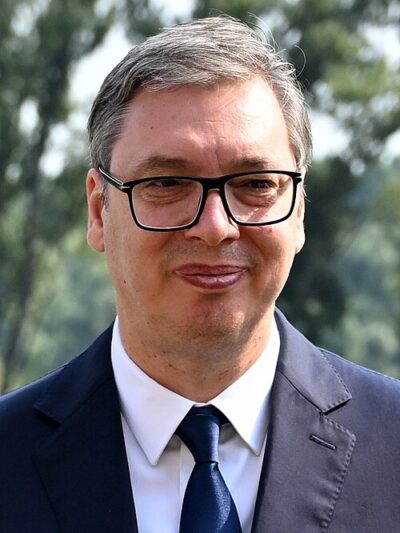
Aleksandar Vučić
Aleksandar Vučić is the 5th President of the Republic of Serbia. Born March 5, 1970, in Belgrade. Positions held include Minister of Defense of Serbia (2012–2013), Minister of Information (1998–2000) and Prime Minister of Serbia (2014–2017). Educated at University of Belgrade Faculty of Law and Zemun Gymnasium. Awards include Order of Alexander Nevsky, Dostyk Order of grade I and Order of the Republika Srpska.
Facts
40 facts · 1 confirmed by two sources · 16 cited · 23 from one source
Where this comes from
Papalocal keeps its own record. It started from these sources; what each one said is kept here as it was copied, so a change on their side never changes this page by itself. Tap one to read its version.
What Wikidata says · copied November 16, 2026 · revision 2563370701
- Described as
- 5th President of the Republic of Serbia
- Born
- March 5, 1970 · 3 references
- Born in
- Belgrade · 1 reference
- Citizen of
- Serbia; Socialist Federal Republic of Yugoslavia; Federal Republic of Yugoslavia; Serbia and Montenegro
- Occupation
- politician · 2 references; lawyer; head of government · 1 reference
- Positions held
- Minister of Defense of Serbia (2012–2013); Minister of Information (1998–2000); Prime Minister of Serbia (2014–2017); Deputy Prime Minister of Serbia (2012–2014); President of Serbia (2017–2026) · 1 reference; member of the National Assembly of Serbia; Representative of the Parliamentary Assembly of the Council of Europe (2006–2007) · 1 reference; defence minister · 1 reference
- Political party
- Serbian Progressive Party (2008–); Serbian Radical Party (1993–2008)
- Education
- University of Belgrade Faculty of Law (1988–1994); Zemun Gymnasium; University of Belgrade · 1 reference
- Member of
- Parliamentary Assembly of the Council of Europe
- Awards
- Order of Alexander Nevsky (2019) · 1 reference; Dostyk Order of grade I (2018) · 2 references; Order of the Republika Srpska (2018) · 1 reference; honorary doctor of the Moscow State Institute of International Relations · 1 reference; Collar of the Order of the White Lion (2021) · 1 reference; Grand Cross of the Order of Saint-Charles (2022) · 2 references; Order of Makarios III · 1 reference; Order of Saint Mark of Alexandria (2017) · 1 reference; Order of St. Sava (2019) · 1 reference; Order of Saint-Charles · 1 reference; Hungarian Order of Merit · 1 reference
- Spouse
- Tamara Vučić (2013–) · 1 reference; Ksenija Vučić (1997–2011) · 1 reference
- Siblings
- Andrej Vučić · 1 reference
- Religion
- Serbian Orthodox Church · 1 reference
- Height
- 1.99 m (6 ft 6 in) · 1 reference
- Website
- https://vucic.rs/
- Wikipedias with a page
- 90
Wikidata item Q222031 (wikidata.org/wiki/Q222031), public domain (CC0). Copied November 16, 2026.
What Wikipedia says · copied November 16, 2026 · revision 1384872446
Aleksandar Vučić (born 5 March 1970) is a Serbian politician who led Serbia in positions of the prime minister of Serbia from 2014 to 2017 and the president of Serbia from 2017 to 2026. A founding member of the Serbian Progressive Party (SNS), its president from 2012 to 2023 and its de facto leader after the formal resignation, he held the formal positions of first deputy prime minister from 2012 to 2014, and after becoming the prime minister, he and the SNS gradually consolidated control over the country's politics and led its democratic backsliding. His rule ended in 2026 with the SNS losing the majority in parliamentary elections.
Born in Belgrade, Vučić graduated as a lawyer from the Faculty of Law of University of Belgrade. Vučić began his political career in 1993, as a member of the far-right Serbian Radical Party (SRS) in the National Assembly of Serbia. In 1995, he became the secretary-general of SRS. He was appointed minister of information in 1998 in the government of Mirko Marjanović. During his tenure as minister, which lasted until the overthrow of Slobodan Milošević in 2000, Vučić introduced restrictive measures against journalists and banned foreign TV networks. After 2000, he was one of the most prominent figures in the Serbian opposition. Together with Tomislav Nikolić, Vučić left SRS and co-founded SNS in 2008, initially serving as its deputy president. SNS became the largest party in the 2012 election and SNS soon formed a government with the Socialist Party of Serbia. Vučić was appointed first deputy prime minister and elected president of SNS.
Despite not being prime minister, Vučić held the most influence and power due to being the leader of the largest party in the government. He was one of the crucial figures in cooperation and European Union (EU)-mediated dialogue between the governments of Kosovo and Serbia, advocating the implementation of the Brussels Agreement on the normalization of their relations. Vučić became prime minister in 2014, leading to the establishment of a dominant-party system. He continued the accession process to the EU by privatizing state businesses and liberalizing the economy. EU opened first chapters during the accession conference with the Serbian delegation led by Vučić in 2015. In 2017, Vučić was elected president of Serbia. He was re-elected in 2022. In 2026, he resigned as president to lead the SNS list "Aleksandar Vučić – United Serbia" as its candidate for prime minister in the 2026 Serbian parliamentary election. His list lost to the Student List, which won an absolute majority of seats, and Vučić conceded defeat on election night.
During his tenure as president, Vučić initiated Open Balkan, an economic zone of Balkan countries intended to guarantee "four freedoms", and signed an agreement in September 2020 to normalize economic relations with Kosovo. A populist politician, Vučić supports the accession of Serbia to the EU and also wants to retain good relations with Russia and China. Observers have described Vučić's rule as an authoritarian, autocratic or illiberal regime, citing curtailed press freedom and a decline in civil liberties. Supporters of Vučić's administration highlight economic growth and the pursuit of pragmatic and balanced policies.
- Born, in its opening lines
- March 5, 1970
From the Wikipedia article “Aleksandar Vučić” (en.wikipedia.org/wiki/Aleksandar_Vučić), by its contributors, under CC BY-SA 4.0 (creativecommons.org/licenses/by-sa/4.0/). Copied November 16, 2026; not changed.
Confirmed Two sources agree. Cited One source, and it names where it got it. One source One source, without a reference of its own. Sources disagree The sources disagree. We show the best-supported value and keep theirs below.
