
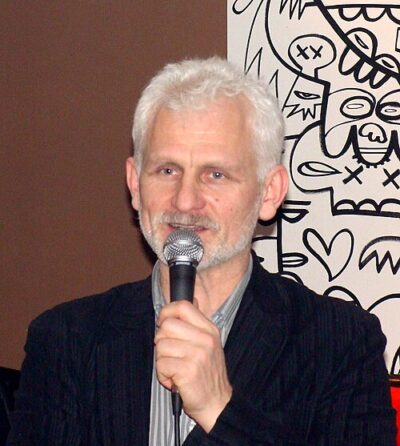
Ales Bialiatski
Ales Bialiatski is a Belarusian activist, Nobel laureate. Born September 25, 1962, in Vyartsilya. Positions held include The Minsk City Council of Deputies (1991–1996). Educated at Faculty of Philology, Gomel State University and Institute of Literature of the National Academy of Sciences of Belarus. Awards include Per Anger Prize, Homo Homini Award and Václav Havel Human Rights Prize.
Facts
46 facts · 1 confirmed by two sources · 16 cited · 29 from one source
Where this comes from
Papalocal keeps its own record. It started from these sources; what each one said is kept here as it was copied, so a change on their side never changes this page by itself. Tap one to read its version.
What Wikidata says · copied November 16, 2026 · revision 2568354258
- Described as
- Belarusian activist, Nobel laureate (born 1962)
- Other names
- Ales Viktaravich Bialiatski
- Born
- September 25, 1962 · 2 references
- Born in
- Vyartsilya · 1 reference
- Name at birth
- Аляксандр Віктаравіч Бяляцкі
- Citizen of
- Soviet Union · 1 reference; Belarus
- Occupation
- writer; human rights defender · 2 references; literary scholar · 1 reference; literary critic · 1 reference; literary historian · 1 reference; dissident · 1 reference; teacher · 1 reference; man of letters · 1 reference
- Positions held
- The Minsk City Council of Deputies (1991–1996)
- Worked for
- Viasna Human Rights Centre; Maksim Bahdanovič Literary Museum, Minsk · 1 reference
- Education
- Faculty of Philology, Gomel State University (–1984); Institute of Literature of the National Academy of Sciences of Belarus (–1989)
- Member of
- Talaka; Coordination Council for the Transfer of Power; Union of Belarusian Writers; Belarusian PEN Centre · 1 reference; Tuteyshyya · 1 reference; Belarusian Popular Front · 1 reference; Martyrology of Belarus · 1 reference; belarusian catholic community · 1 reference
- Awards
- Per Anger Prize (2006); Homo Homini Award (2005); Václav Havel Human Rights Prize (2013); Petra-Kelly-Preis (2012); Andrei Sakharov Freedom Award (2006); honorary citizen of Paris (2012); Belarusian Democratic Republic 100th Jubilee Medal; Right Livelihood Award (2020) · 1 reference; Ales Adamovich Prize (2014); Award of Francišak Alachnovič (2013); Nobel Peace Prize (2022) · 2 references; honorary citizen of Syracuse (2014); honorary citizen of Genoa (2010); Order of the Pahonia (2024); Civil Rights Defender of the Year Award (2014) · 1 reference
- Field
- literary studies · 1 reference; literary criticism · 1 reference; history of literature · 1 reference; human rights protection · 1 reference
- Spouse
- Natalia Pinchuk
- Wikipedias with a page
- 62
Wikidata item Q118263 (wikidata.org/wiki/Q118263), public domain (CC0). Copied November 16, 2026.
What Wikipedia says · copied November 16, 2026 · revision 1344455176
Ales Viktaravich Bialiatski (Belarusian: Алесь Віктаравіч Бяляцкі, romanized: Aleś Viktaravič Bialacki; born 25 September 1962) is a Belarusian human rights defender, pro-democracy activist, and writer. He is chair of the Viasna Human Rights Centre. He was held as a prisoner of conscience. An activist for Belarusian independence and democracy since the early 1980s, Bialiatski is a founding member of Viasna and the Belarusian Popular Front, serving as leader of the latter from 1996 to 1999. He is also a member of the Coordination Council of the Belarusian opposition. He has been called "a pillar of the human rights movement in Eastern Europe" by The New York Times, and recognised as a prominent pro-democracy activist in Belarus.
Bialiatski's defence of human rights in Belarus has brought him numerous international accolades. In 2020, he won the Right Livelihood Award, widely known as the "Alternative Nobel Prize". In 2022, Bialiatski was awarded the 2022 Nobel Peace Prize, along with the organisations Memorial and Centre for Civil Liberties.
Bialiatski has been imprisoned twice; firstly from 2011 to 2014, and from 2021 to 2025, on both occasions on charges of tax evasion. Bialiatski, as well as other human rights activists, have called the charges politically motivated.
On 3 March 2023, Bialiatski was sentenced in Minsk to ten years in prison for "cash smuggling" as well as "financing actions and groups that grossly violated public order." Human rights activists view the charges as fabricated in order to silence Bialiatski and his movement after he was awarded the Nobel Peace Prize.
- Born, in its opening lines
- September 25, 1962
From the Wikipedia article “Ales Bialiatski” (en.wikipedia.org/wiki/Ales_Bialiatski), by its contributors, under CC BY-SA 4.0 (creativecommons.org/licenses/by-sa/4.0/). Copied November 16, 2026; not changed.
Confirmed Two sources agree. Cited One source, and it names where it got it. One source One source, without a reference of its own. Sources disagree The sources disagree. We show the best-supported value and keep theirs below.
