
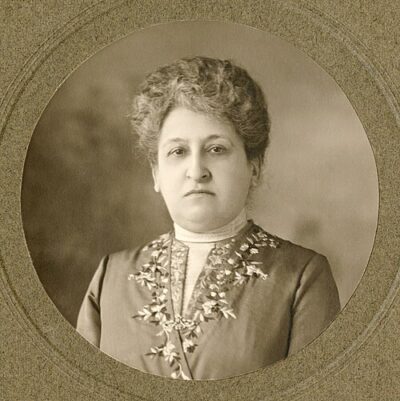
Aletta Jacobs
Aletta Jacobs was a Dutch physician and feminist, editor. Born February 9, 1854, in Sappemeer. Died August 10, 1929, in Baarn. Educated at University of Groningen.
Facts
22 facts · 2 confirmed by two sources · 8 cited · 12 from one source
Where this comes from
Papalocal keeps its own record. It started from these sources; what each one said is kept here as it was copied, so a change on their side never changes this page by itself. Tap one to read its version.
What Wikidata says · copied November 16, 2026 · revision 2570356593
- Described as
- Dutch physician and feminist, editor (1854–1929)
- Other names
- Aletta Gerritsen, Aletta Henriëtte Gerritsen, Aletta Henriëtte Jacobs
- Born
- February 9, 1854 · 5 references
- Died
- August 10, 1929 · 5 references
- Born in
- Sappemeer · 1 reference
- Died in
- Baarn · 1 reference
- Name at birth
- Aletta Henriëtte Jacobs
- Citizen of
- Kingdom of the Netherlands · 1 reference
- Occupation
- physician · 1 reference; women's rights activist; peace activist; editor · 1 reference; suffragist; feminist · 1 reference
- Political party
- Free-thinking Democratic League · 1 reference
- Education
- University of Groningen
- Member of
- Women's International League for Peace and Freedom; International Committee of Women for Permanent Peace; Vereeniging voor Verbetering van Vrouwenkleeding · 1 reference
- Spouse
- Carel Victor Gerritsen
- Siblings
- Charlotte Jacobs; Eduard Jacobs
- Religion
- Judaism
- Lived in
- Noorderstraat 19 (1858–1874) · 1 reference
- Wikipedias with a page
- 38
Wikidata item Q463478 (wikidata.org/wiki/Q463478), public domain (CC0). Copied November 16, 2026.
What Wikipedia says · copied November 16, 2026 · revision 1382507429
Aletta Henriëtte Jacobs (Dutch pronunciation: [aːˈlɛtaː ɦɑ̃ːriˈjɛtə ˈjaːkɔps]; 9 February 1854 – 10 August 1929) was a Dutch physician and women's suffrage activist. As the first woman to officially graduate from a Dutch university, she became one of the first female physicians in the Netherlands. In 1882, she founded the world's first birth control clinic and was a leader in both the Dutch and international women's movements. She led campaigns aimed at deregulating prostitution, improving women's working conditions, promoting peace and calling for women's right to vote.
Born in the mid-nineteenth century, Jacobs yearned to become a doctor like her father. Despite existing barriers, she fought to gain entry to higher education and graduated in 1879 with the first doctorate in medicine earned by a woman in the Netherlands. Providing medical services to women and children, she grew concerned over the health of working women, recognizing that as laws did not provide adequate protection for their health, their economic stability was compromised. She opened a free clinic to educate poor women about hygiene and child care and in 1882 expanded her services to include distribution of contraception information and devices. Though she continued to practice medicine until 1903, Jacobs increasingly turned her attention to activism with a view to improving women's lives.
From 1883, when Jacobs first challenged the authorities on women's right to vote, she strove throughout her life to change laws that limited women's access to equality. She was successful in her campaign to establish mandatory break laws in retail workers' employment and in attaining the vote for Dutch women in 1919. Involved in the international women's movement, Jacobs traveled throughout the world speaking about women's issues and documenting the socio-economic and political status of women. She was instrumental in the establishment of the Women's International League for Peace and Freedom and an active participant in the peace movement. She is recognized internationally for her contributions to women's rights and status.
- Born, in its opening lines
- February 9, 1854
- Died, in its opening lines
- August 10, 1929
From the Wikipedia article “Aletta Jacobs” (en.wikipedia.org/wiki/Aletta_Jacobs), by its contributors, under CC BY-SA 4.0 (creativecommons.org/licenses/by-sa/4.0/). Copied November 16, 2026; not changed.
Confirmed Two sources agree. Cited One source, and it names where it got it. One source One source, without a reference of its own. Sources disagree The sources disagree. We show the best-supported value and keep theirs below.
