
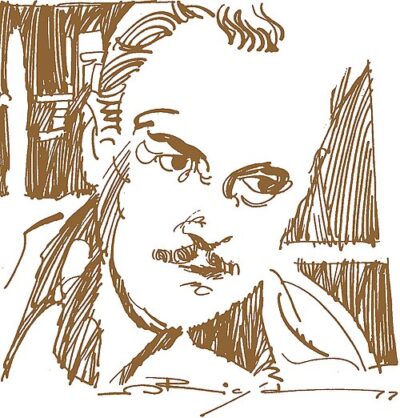
Alex Raymond
Alex Raymond was an American comic strip artist and creator of Flash Gordon. Born October 2, 1909, in New Rochelle. Died September 6, 1956, in Westport. Known for Flash Gordon, Rip Kirby and Secret Agent X-9. Educated at Iona Preparatory School and Grand Central School of Art. Awards include Reuben Award and Will Eisner Hall of Fame.
Facts
20 facts · 2 confirmed by two sources · 7 cited · 11 from one source
Where this comes from
Papalocal keeps its own record. It started from these sources; what each one said is kept here as it was copied, so a change on their side never changes this page by itself. Tap one to read its version.
What Wikidata says · copied November 16, 2026 · revision 2560207540
- Described as
- American comic strip artist and creator of Flash Gordon (1909–1956)
- Other names
- Alexander Gillespie Raymond
- Born
- October 2, 1909 · 13 references
- Died
- September 6, 1956 · 9 references
- Born in
- New Rochelle · 1 reference
- Died in
- Westport · 1 reference
- Cause of death
- traffic collision
- Citizen of
- United States
- Occupation
- military officer; screenwriter · 1 reference; comics artist · 2 references; cartoonist · 1 reference
- Education
- Iona Preparatory School · 1 reference; Grand Central School of Art
- Known for
- Flash Gordon; Rip Kirby; Secret Agent X-9; Jungle Jim
- Awards
- Reuben Award (1949) · 1 reference; Will Eisner Hall of Fame (1996) · 1 reference
- Siblings
- Jim Raymond
- Military branch
- United States Marine Corps
- Wikipedias with a page
- 23
Wikidata item Q919115 (wikidata.org/wiki/Q919115), public domain (CC0). Copied November 16, 2026.
What Wikipedia says · copied November 16, 2026 · revision 1379349097
Alexander Gillespie Raymond Jr. (October 2, 1909 – September 6, 1956) was an American cartoonist and illustrator who was best known for creating the Flash Gordon comic strip for King Features Syndicate in 1934. The strip was subsequently adapted into many other media, from three Universal movie serials (1936's Flash Gordon, 1938's Flash Gordon's Trip to Mars, and 1940's Flash Gordon Conquers the Universe) to a 1950s television series and a 1980 feature film.
Raymond's father loved drawing and encouraged his son to draw from an early age. In the early 1930s, this led Raymond to become an assistant illustrator on strips such as Tillie the Toiler and Tim Tyler's Luck. Towards the end of 1933, Raymond created the epic Flash Gordon science fiction comic strip to compete with the popular Buck Rogers comic strip. Before long, Flash was the more popular strip. Raymond also worked on the jungle adventure saga Jungle Jim and spy adventure Secret Agent X-9 concurrently with Flash, though his increasing workload caused him to leave Secret Agent X-9 to another artist by 1935. He left the strips in 1944 to join the Marines, saw combat in the Pacific Ocean theater in 1945, and was demobilized in 1946. Upon his return to civilian life, Raymond created and illustrated the much-heralded Rip Kirby, a private detective comic strip. In 1956, Raymond was killed in a car crash at the age of 46.
He became known as "the artist's artist" and his much-imitated style can be seen on the many strips that he illustrated. Raymond worked from live models furnished by Manhattan's Walter Thornton Agency, as indicated in "Modern Jules Verne," a profile of Raymond published in the Dell Four-Color Flash Gordon #10 (1942), showing how Thornton model Patricia Quinn posed as a character in the strip.
Numerous artists have cited Raymond as an inspiration for their work, including comic artists Jack Kirby, Bob Kane, Russ Manning, and Al Williamson. George Lucas cited Raymond as a major influence for Star Wars. He was inducted into the Will Eisner Comic Book Hall of Fame in 1996. Maurice Horn stated that Raymond unquestionably possessed "the most versatile talent" of all the comic strip creators. He has also described his style as "precise, clear, and incisive." Carl Barks described Raymond as a man "who could combine craftsmanship with emotions and all the gimmicks that went into a good adventure strip". Raymond's influence on other cartoonists was considerable during his lifetime and did not diminish after his death.
- Born, in its opening lines
- October 2, 1909
- Died, in its opening lines
- September 6, 1956
From the Wikipedia article “Alex Raymond” (en.wikipedia.org/wiki/Alex_Raymond), by its contributors, under CC BY-SA 4.0 (creativecommons.org/licenses/by-sa/4.0/). Copied November 16, 2026; not changed.
Confirmed Two sources agree. Cited One source, and it names where it got it. One source One source, without a reference of its own. Sources disagree The sources disagree. We show the best-supported value and keep theirs below.
