
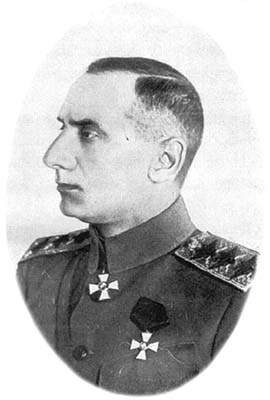
Alexander Kolchak
Alexander Kolchak was a Russian admiral and military leader of the White movement. Born November 4, 1874, in Alexandrovskoye. Died February 7, 1920, in Irkutsk. Positions held include Supreme Ruler of Russia (1918–1920) and Supreme Commander. Educated at Naval Cadet Corps and St. Petersburg Naval Institute. Awards include Constantin Medal, Order of Saint Anna, 1st class with swords and Order of Saint Anna, 2nd class.
Facts
48 facts · 1 confirmed by two sources · 5 cited · 41 from one source · 1 where the sources disagree
What’s different
- Born: we show November 4, 1874 (Sources disagree). Wikipedia says November 16, 1874
Where this comes from
Papalocal keeps its own record. It started from these sources; what each one said is kept here as it was copied, so a change on their side never changes this page by itself. Tap one to read its version.
What Wikidata says · copied November 16, 2026 · revision 2568539250
- Described as
- Russian admiral and military leader of the White movement (1874-1920)
- Other names
- Aleksandr Vasilyevich Kolchak, Aleksandr Vasil'evič Kolčak, Aleksandr Vasil'evich Kolchak, Alexander Vasilyevich Kolchak
- Born
- November 4, 1874 · 3 references
- Died
- February 7, 1920 · 6 references
- Born in
- Alexandrovskoye · 2 references
- Died in
- Irkutsk · 3 references
- Cause of death
- gunshot wound
- Citizen of
- Russian Empire; Russian State; Russian Republic
- Occupation
- politician; explorer; military officer; oceanographer; soldier · 1 reference; glaciologist; naval officer · 1 reference; admiral · 1 reference
- Positions held
- Supreme Ruler of Russia (1918–1920); Supreme Commander
- Political party
- White movement · 1 reference
- Education
- Naval Cadet Corps; St. Petersburg Naval Institute
- Awards
- Constantin Medal (1906); Order of Saint Anna, 1st class with swords (1917); Order of Saint Anna, 2nd class (1910); Order of Saint Anna, 4th class (1904) · 1 reference; Order of Saint Stanislaus, 1st class with swords (1916); Order of Saint Stanislaus, 2nd class with swords (1905); Order of Saint Vladimir 4th class with swords and bow (2 times) (1903, 1907); Order of St. Vladimir, 3rd class with Swords (1915); Order of St. George, 3rd class (1919); Order of St. George, 4th class (1915); Gold Sword for Bravery (1905); Russo-Japanese War Medal (1906); Medal "In memory of the 300th anniversary of Romanov dynasty" (1913); Medal In memory of Alexander III (1896); Medal In memory of the 200th anniversary of Gangut battle (1915)
- Spouse
- Sofia Kolchak
- Children
- Rostislav Kolchak
- Father
- Vassili Ivanovitch Koltchak
- Mother
- Olga Kolchak
- Siblings
- Ekaterina Kolchak
- Religion
- Eastern Orthodoxy · 1 reference
- Military branch
- Imperial Russian Navy; Russian Army; White Fleet
- Military rank
- vice admiral (1916); admiral (1918)
- Lived in
- Saint Petersburg
- Wikipedias with a page
- 75
Wikidata item Q185718 (wikidata.org/wiki/Q185718), public domain (CC0). Copied November 16, 2026.
What Wikipedia says · copied November 16, 2026 · revision 1384511381
Admiral Alexander Vasilyevich Kolchak (Russian: Алекса́ндр Васи́льевич Колча́к; 16 November [O.S. 4 November] 1874 – 7 February 1920) was a Russian navy officer and polar explorer who led the White movement in the Russian Civil War. When he assumed the title of Supreme Ruler of Russia in 1918, Kolchak headed a military dictatorship, which ruled over the territory of the former Russian Empire controlled by the Whites. He was a proponent of Russian nationalism and militarism, and opposed democracy as a principle which he believed was tied to pacifism, internationalism, and socialism.
Kolchak served in the Imperial Russian Navy and fought in the Russo-Japanese War and World War I. The son of a naval artillery officer, he graduated from the Naval Cadet Corps and went on to become an accomplished oceanographer and Arctic explorer. He was involved in several expeditions to northern Russia, including to the New Siberian Islands, and became the youngest vice admiral in the Imperial Navy. He was wounded and taken prisoner during the Russo-Japanese War at the Siege of Port Arthur. When he returned to Russia he lobbied the State Duma to strengthen the fleet by introducing submarines and aircraft. Kolchak was the Baltic Fleet Chief of Operations when World War I broke out and was made the Commander of the Black Sea Fleet shortly before the February Revolution. When Emperor Nicholas II asked the commanders of each army group and fleet for their opinion on whether he should abdicate the throne, Kolchak was the only one who opposed the move.
During the Russian Revolution of 1917, Kolchak was popular among conservative newspapers, who saw him as a potential military dictator. Early in the Russian Civil War, he briefly served as the Minister of War and Navy in the Provisional All-Russian Government – the first government that was recognized by all White military and political forces east of Urals, at least nominally – until a November 1918 coup saw him installed as leader and all authority was transferred to his own government. His government was based in Omsk, in southwestern Siberia. When Kolchak assumed the title of Supreme Ruler, his authority was recognized by the other leaders of the White movement, although Anton Denikin enjoyed more power than Kolchak.
After initial successes in early 1919, Kolchak's forces lost ground due to lack of support from the local populace and failure to unite the leaders of the counterrevolutionary movements. Omsk fell to the Red Army in November 1919 during the Great Siberian Ice March, compelling Kolchak to transfer his headquarters to Irkutsk. In December, he was betrayed and detained by the chief of the Allied military mission in Siberia, Maurice Janin, and the Czechoslovak Legion, who handed him over to local Socialist-Revolutionaries in January 1920. The Bolsheviks executed him the following month in Irkutsk.
- Born, in its opening lines
- November 16, 1874
- Died, in its opening lines
- February 7, 1920
From the Wikipedia article “Alexander Kolchak” (en.wikipedia.org/wiki/Alexander_Kolchak), by its contributors, under CC BY-SA 4.0 (creativecommons.org/licenses/by-sa/4.0/). Copied November 16, 2026; not changed.
Confirmed Two sources agree. Cited One source, and it names where it got it. One source One source, without a reference of its own. Sources disagree The sources disagree. We show the best-supported value and keep theirs below.
