
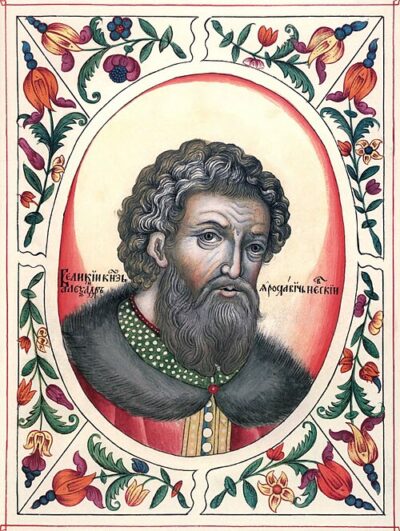
Alexander Nevsky
Alexander Nevsky was a political and military figure of Kievan Rus'. Born May 13, 1220, in Vladimir. Died November 14, 1263, in Gorodets. Positions held include Grand Prince of Kiev (1249–1263), Grand Prince of Novgorod (3 times) (1228–1259) and Prince of Pereyaslavl (1246–1263).
Facts
25 facts · 1 confirmed by two sources · 0 cited · 22 from one source · 2 where the sources disagree
What’s different
- Born: we show May 13, 1220 (Sources disagree). Wikipedia says May 13, 1221
- Born in: we show Vladimir (Sources disagree). Wikidata also lists Pereslavl-Zalessky
Where this comes from
Papalocal keeps its own record. It started from these sources; what each one said is kept here as it was copied, so a change on their side never changes this page by itself. Tap one to read its version.
What Wikidata says · copied November 16, 2026 · revision 2568537307
- Described as
- political and military figure of Kievan Rus' (1246–1263)
- Other names
- Aleksandr Yaroslavich Nevsky, Saint Alexander Nevsky, Alexander Yaroslavich Nevsky
- Born
- May 13, 1220
- Died
- November 14, 1263 · 2 references
- Born in
- Pereslavl-Zalessky; Vladimir · 1 reference
- Died in
- Gorodets
- Buried in
- Alexander Nevsky Lavra
- Cause of death
- pneumonia
- Citizen of
- Kievan Rus' · 1 reference; Grand Principality of Vladimir
- Occupation
- ruler; military leader · 1 reference
- Positions held
- Grand Prince of Kiev (1249–1263); Grand Prince of Novgorod (3 times) (1228–1259); Prince of Pereyaslavl (1246–1263)
- Spouse
- Alexandra Brachyslavna (1238–) · 2 references
- Children
- Dmitry of Pereslavl; Andrey of Gorodets; Daniel of Moscow; Vassili Aleksandrovitch
- Father
- Yaroslav II of Vladimir
- Mother
- Feodossiya Mstislavna
- Siblings
- Andrey II of Vladimir · 2 references; Yaroslav of Tver; Vasily of Kostroma; Mikhail Khorobrit
- Religion
- Eastern Orthodoxy
- Wikipedias with a page
- 81
Wikidata item Q174044 (wikidata.org/wiki/Q174044), public domain (CC0). Copied November 16, 2026.
What Wikipedia says · copied November 16, 2026 · revision 1380937363
Alexander Yaroslavich Nevsky (Russian: Александр Ярославич Невский; IPA: [ɐlʲɪˈksandr jɪrɐˈsɫavʲɪtɕ ˈnʲɛfskʲɪj] ; monastic name: Aleksiy; 13 May 1221 – 14 November 1263) was Prince of Novgorod (1236–1240; 1241–1256; 1258–1259) and Grand Prince of Vladimir (1252–1263).
A grandson of Vsevolod the Big Nest, Nevsky rose to legendary status after victories over Swedish invaders in the Battle of the Neva (1240), which earned him the title "Nevsky" in the 15th century, and over German crusaders in the Battle on the Ice (1242). He agreed to pay tribute to the Golden Horde, which allowed him to preserve the Eastern Orthodox Church, while fighting against foreign powers to the west and the south. Macarius, Metropolitan of Moscow canonized Alexander Nevsky as a saint of the Russian Orthodox Church in 1547.
He is considered "one of the great heroes of Russian history", being credited with having "saved the Russian people from Catholicism and being enslaved by the Germans". Although he was already an important figure during his lifetime, his image as the defender of Russia has survived in the centuries after his death. Nevsky's military successes led his image to be used by Peter the Great in the construction of Saint Petersburg. His image was also used to promote patriotism in the Soviet Union, especially during World War II. The 1938 film Alexander Nevsky cemented Nevsky's reputation as a Russian savior. Critics of his legacy argue that the size and importance of his military victories were exaggerated for political purposes, and that he helped ensure the Golden Horde's dominance over Russia.
- Born, in its opening lines
- May 13, 1221
- Died, in its opening lines
- November 14, 1263
From the Wikipedia article “Alexander Nevsky” (en.wikipedia.org/wiki/Alexander_Nevsky), by its contributors, under CC BY-SA 4.0 (creativecommons.org/licenses/by-sa/4.0/). Copied November 16, 2026; not changed.
Confirmed Two sources agree. Cited One source, and it names where it got it. One source One source, without a reference of its own. Sources disagree The sources disagree. We show the best-supported value and keep theirs below.
