
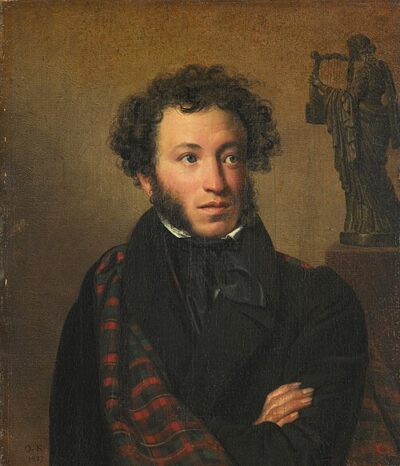
Alexander Pushkin
Alexander Pushkin was a Russian poet, playwright, and novelist. Born May 26, 1799, in Moscow. Died January 29, 1837, in Saint Petersburg. Positions held include member of Filiki Eteria. Known for Eugene Onegin, The Captain's Daughter and Boris Godunov. Educated at Tsarskoye Selo Lyceum.
Facts
53 facts · 0 confirmed by two sources · 10 cited · 41 from one source · 2 where the sources disagree
What’s different
- Born: we show May 26, 1799 (Sources disagree). Wikipedia says June 6, 1799
- Died: we show January 29, 1837 (Sources disagree). Wikipedia says February 10, 1837
Where this comes from
Papalocal keeps its own record. It started from these sources; what each one said is kept here as it was copied, so a change on their side never changes this page by itself. Tap one to read its version.
What Wikidata says · copied November 16, 2026 · revision 2568543639
- Described as
- Russian poet, playwright, and novelist (1799–1837)
- Other names
- Aleksandr Serge'evich Pushkin, Aleksandr Sergeyevich Pushkin, Aleksandr Pushkin, Alexander Sergeyevich Pushkin, Pushkin, Pouchkine Aleksandr Sergueevitch
- Born
- May 26, 1799 · 5 references
- Died
- January 29, 1837 · 4 references
- Born in
- Moscow · 6 references
- Died in
- Saint Petersburg · 5 references
- Buried in
- Svyatogorsky Monastery · 1 reference
- Cause of death
- gunshot wound · 1 reference
- Citizen of
- Russian Empire · 1 reference
- Occupation
- poet · 4 references; playwright · 1 reference; literary critic; translator · 1 reference; historian; novelist; librettist · 2 references; book collector
- Positions held
- member of Filiki Eteria
- Education
- Tsarskoye Selo Lyceum (1811–1817)
- Member of
- Arzamas Society; Green Lamp Society
- Genre
- prose; opinion journalism; criticism · 1 reference; verse novel · 1 reference; robber novel · 1 reference; short novel · 1 reference
- Known for
- Eugene Onegin; The Captain's Daughter; Boris Godunov; Ruslan and Ludmila; The Prophet · 1 reference; The Tale of the Priest and of His Workman Balda · 1 reference; The Tale of the Fisherman and the Fish · 1 reference; The Tale of the Dead Princess and the Seven Knights · 1 reference; The Tale of the Golden Cockerel · 1 reference
- Field
- study of history; dramaturgy; translation; criticism
- Spouse
- Natalia Pushkina (1831–1837) · 2 references
- Children
- Maria Pushkina; Natalya Pushkina · 1 reference; Alexander Alexandrovich Pushkin · 1 reference; Grigory Pushkin
- Father
- Sergey Pushkin · 2 references
- Mother
- Nadezhda Pushkina · 1 reference
- Siblings
- Olga Pavlischeva; Lev Sergeyevich Pushkin · 2 references
- Religion
- Eastern Orthodoxy
- Lived in
- Simferopol (1820); Chișinău (1820–1823); Odesa (1823–1824); Moscow (2 times) (1829–1833) · 1 reference; Yaropolets (1833) · 1 reference
- Wikipedias with a page
- 245
Wikidata item Q7200 (wikidata.org/wiki/Q7200), public domain (CC0). Copied November 16, 2026.
What Wikipedia says · copied November 16, 2026 · revision 1383399866
Alexander Sergeyevich Pushkin (6 June [O.S. 26 May] 1799 – 10 February [O.S. 29 January] 1837) was a Russian poet, playwright, and novelist of the Romantic era. He is considered by many to be the greatest Russian poet, as well as the founder of modern Russian literature.
Pushkin was born into the Russian nobility in Moscow. His father, Sergey Lvovich Pushkin, belonged to an old noble family. One of his maternal great-grandfathers was Abram Petrovich Gannibal, a nobleman and military general of African origin who was kidnapped from his homeland by the Ottomans, then freed by Peter the Great and raised in the Emperor's court household as his godson.
Pushkin published his first poem at the age of 15, and was widely recognized by the literary establishment by the time of his graduation from the Tsarskoye Selo Lyceum. Upon graduation from the Lyceum, Pushkin recited his controversial poem "Ode to Liberty", one of several that led to his exile by Emperor Alexander I. While under strict surveillance by the Emperor's political police and unable to publish, Pushkin wrote his most famous play, Boris Godunov. His grand opus novel in verse Eugene Onegin was serialized between 1825 and 1832. Pushkin was fatally wounded in a duel with his wife's alleged lover (her sister's husband), Georges-Charles de Heeckeren d'Anthès, also known as Dantes-Gekkern, a French officer serving with the Russian Chevalier Guard Regiment.
- Born, in its opening lines
- June 6, 1799
- Died, in its opening lines
- February 10, 1837
From the Wikipedia article “Alexander Pushkin” (en.wikipedia.org/wiki/Alexander_Pushkin), by its contributors, under CC BY-SA 4.0 (creativecommons.org/licenses/by-sa/4.0/). Copied November 16, 2026; not changed.
Confirmed Two sources agree. Cited One source, and it names where it got it. One source One source, without a reference of its own. Sources disagree The sources disagree. We show the best-supported value and keep theirs below.
