
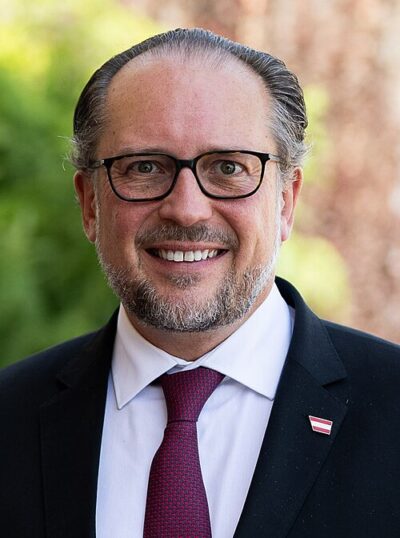
Alexander Schallenberg
Alexander Schallenberg is a Chancellor of Austria in 2021 and 2025. Born June 20, 1969, in Bern. Positions held include Federal Minister of Foreign Affairs of Austria (2019–2025), Federal Chancellor of Austria (2 times) (2021–2025) and Chancellery minister (2019–2020). Educated at University of Vienna and Panthéon-Assas University Paris. Awards include Order of Merit of the Principality of Liechtenstein and Knight Grand Cross of the Order of Merit of the Italian Republic.
Facts
17 facts · 1 confirmed by two sources · 10 cited · 6 from one source
Where this comes from
Papalocal keeps its own record. It started from these sources; what each one said is kept here as it was copied, so a change on their side never changes this page by itself. Tap one to read its version.
What Wikidata says · copied November 16, 2026 · revision 2562955964
- Described as
- Chancellor of Austria in 2021 and 2025
- Other names
- Alexander Georg Nicolas Schallenberg
- Born
- June 20, 1969 · 2 references
- Born in
- Bern · 1 reference
- Citizen of
- Austria
- Occupation
- jurist · 1 reference; politician · 1 reference
- Positions held
- Federal Minister of Foreign Affairs of Austria (2019–2025); Federal Chancellor of Austria (2 times) (2021–2025) · 1 reference; Chancellery minister (2019–2020) · 1 reference
- Political party
- Austrian People's Party (2020–) · 1 reference
- Education
- University of Vienna (1989–1994) · 1 reference; Panthéon-Assas University Paris · 1 reference; College of Europe · 1 reference
- Member of
- Bierlein government; Second Kurz cabinet
- Awards
- Order of Merit of the Principality of Liechtenstein (2019) · 1 reference; Knight Grand Cross of the Order of Merit of the Italian Republic (2020) · 2 references
- Father
- Wolfgang Schallenberg
- Wikipedias with a page
- 64
Wikidata item Q64168538 (wikidata.org/wiki/Q64168538), public domain (CC0). Copied November 16, 2026.
What Wikipedia says · copied November 16, 2026 · revision 1382364741
Alexander Georg Nicolas Schallenberg (Austrian German: [alɛˈksandɐ ˈɡeːɔrɡ ˈnɪkolas ˈʃalənbɛrɡ]; born 20 June 1969) is an Austrian diplomat, jurist, and politician who served as the minister of foreign affairs from 2019 until 2025, briefly interrupted by a period from October until December 2021, when he served as 27th chancellor of Austria, a role he served in an acting capacity again from January to March 2025.
A member of the Austrian People's Party (ÖVP), he held the position in the Bierlein government and Second Kurz government, before briefly serving as chancellor as Kurz's successor from 11 October to 6 December 2021 (Schallenberg government). On 10 January 2025, Schallenberg was appointed acting chancellor by President Alexander Van der Bellen, following the resignation of Karl Nehammer, who himself had served in an Caretaking capacity since October 2024 following the legislative elections the previous month.
A member of the Schallenberg family and a graduate of the College of Europe, Schallenberg was a career diplomat who became a mentor to Kurz when the latter became foreign minister. Kurz appointed him director of strategic foreign policy planning and head of the European department. Schallenberg joined the cabinet as foreign minister in 2019. After Kurz announced his pending resignation on 9 October 2021, Schallenberg was proposed by the ÖVP to replace him as Chancellor of Austria. He was sworn in on 11 October 2021. Schallenberg announced his pending resignation on 2 December 2021, after less than two months in office. His resignation took effect on 6 December; he returned to the position of foreign minister.
- Born, in its opening lines
- June 20, 1969
From the Wikipedia article “Alexander Schallenberg” (en.wikipedia.org/wiki/Alexander_Schallenberg), by its contributors, under CC BY-SA 4.0 (creativecommons.org/licenses/by-sa/4.0/). Copied November 16, 2026; not changed.
Confirmed Two sources agree. Cited One source, and it names where it got it. One source One source, without a reference of its own. Sources disagree The sources disagree. We show the best-supported value and keep theirs below.
