
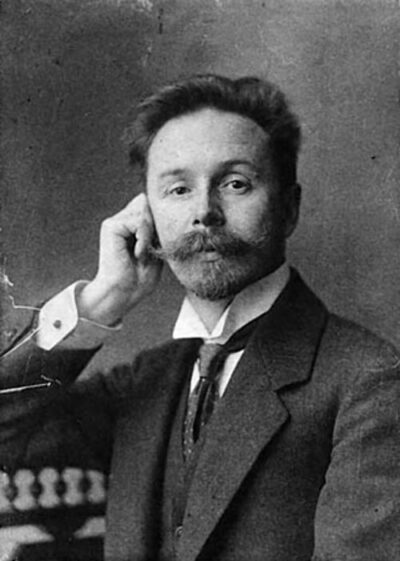
Alexander Scriabin
Alexander Scriabin was a Russian composer and pianist. Born December 25, 1871, in Moscow. Died April 14, 1915, in Moscow. Educated at Moscow Conservatory.
Facts
27 facts · 0 confirmed by two sources · 7 cited · 18 from one source · 2 where the sources disagree
What’s different
- Born: we show December 25, 1871 (Sources disagree). Wikipedia says January 6, 1872
- Died: we show April 14, 1915 (Sources disagree). Wikipedia says April 27, 1915
Where this comes from
Papalocal keeps its own record. It started from these sources; what each one said is kept here as it was copied, so a change on their side never changes this page by itself. Tap one to read its version.
What Wikidata says · copied November 16, 2026 · revision 2568543860
- Described as
- Russian composer and pianist (1872–1915)
- Other names
- Aleksandr Nikolaevich Skryabin, Aleksandr Nikolayevich Skryabin, Scriabin, Alexander Skryabin
- Born
- December 25, 1871 · 1 reference
- Died
- April 14, 1915
- Born in
- Moscow · 5 references
- Died in
- Moscow · 3 references
- Buried in
- Novodevichy Cemetery
- Cause of death
- sepsis
- Citizen of
- Russian Empire
- Occupation
- composer · 3 references; pianist · 1 reference; university teacher
- Worked for
- Moscow Conservatory
- Education
- Moscow Conservatory · 1 reference
- Instrument
- piano
- Field
- Symbolism; symphony; sonata; classical music
- Spouse
- Tatiana Schlözer · 1 reference; Vera Scriabina
- Children
- Julian Scriabin · 1 reference; Ariadna Scriabina; Marina Scriabine
- Father
- Nikolay Skryabin
- Mother
- Lyubov Petrovna Shchetinina
- Siblings
- Ksenia Nikolayevna Scriabin
- Lived in
- Moscow (1911–) · 1 reference
- Website
- http://www.scriabinsociety.com · 1 reference
- Wikipedias with a page
- 79
Wikidata item Q185647 (wikidata.org/wiki/Q185647), public domain (CC0). Copied November 16, 2026.
What Wikipedia says · copied November 16, 2026 · revision 1376897916
Alexander Nikolayevich Scriabin (6 January 1872 [O.S. 25 December 1871] – 27 April [O.S. 14 April] 1915) was a Russian composer and pianist. Initially influenced by Frédéric Chopin, he composed in a relatively tonal, late-Romantic idiom. Later, independently of his contemporary Arnold Schoenberg, Scriabin developed a highly dissonant musical language that transcended traditional tonality without being strictly atonal, aligning with his personal brand of metaphysics. He embraced the concepts of Gesamtkunstwerk and synesthesia, creating a colour-coded circle of fifths inspired by theosophy to associate colours with harmonies. Scriabin is widely considered the primary Russian symbolist composer and a major figure of the Silver Age of Russian Poetry.
Scriabin was an innovator and one of the most controversial composer-pianists of the early 20th century. The Great Soviet Encyclopedia said of him, "no composer has had more scorn heaped on him or greater love bestowed." Leo Tolstoy described Scriabin's music as "a sincere expression of genius." Scriabin's oeuvre exerted a salient influence on the music world over time, and inspired many composers, such as Nikolai Roslavets and Karol Szymanowski. His musical aesthetics have been reevaluated since the 1970s, and his ten published sonatas for piano and other works have been increasingly championed, garnering significant acclaim.
- Born, in its opening lines
- January 6, 1872
- Died, in its opening lines
- April 27, 1915
From the Wikipedia article “Alexander Scriabin” (en.wikipedia.org/wiki/Alexander_Scriabin), by its contributors, under CC BY-SA 4.0 (creativecommons.org/licenses/by-sa/4.0/). Copied November 16, 2026; not changed.
Confirmed Two sources agree. Cited One source, and it names where it got it. One source One source, without a reference of its own. Sources disagree The sources disagree. We show the best-supported value and keep theirs below.
