
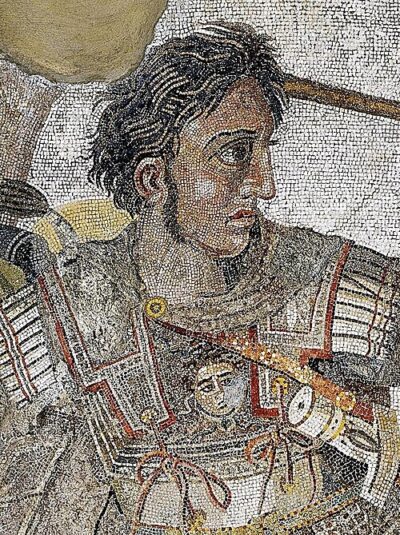
Alexander the Great
Alexander the Great was a king of Macedonia and conqueror of Achaemenid Persia. Born July 20, 356 BC, in Pella. Died June 10, 323 BC, in Babylon. Positions held include king of Macedonia (-336–-323) and pharaoh (-330–-323).

Facts
30 facts · 0 confirmed by two sources · 5 cited · 23 from one source · 2 where the sources disagree
What’s different
- Born: we show July 20, 356 BC (Sources disagree). Wikipedia says July 21, 356
- Died: we show June 10, 323 BC (Sources disagree). Wikipedia says June 11, 323
Where this comes from
Papalocal keeps its own record. It started from these sources; what each one said is kept here as it was copied, so a change on their side never changes this page by itself. Tap one to read its version.
What Wikidata says · copied November 16, 2026 · revision 2568445996
- Described as
- king of Macedonia and conqueror of Achaemenid Persia (356–323 BC)
- Other names
- Alexandros III of Macedonia, Alexander III of Macedonia, Alexandros III, the Great Alexander, Alexandros, Alexander III, Great Alexander, Alexandros the Great, Alexander of Macedon, Sikandar, Alexander of Macedonia, Eskandar
- Born
- July 20, 356 BC · 1 reference
- Died
- June 10, 323 BC
- Born in
- Pella · 1 reference
- Died in
- Babylon
- Buried in
- Alexandria
- Cause of death
- typhoid fever
- Citizen of
- Macedonia
- Occupation
- politician; military leader; monarch
- Positions held
- king of Macedonia (-336–-323); pharaoh (-330–-323)
- Field
- politics · 1 reference; military affairs · 1 reference
- Spouse
- Roxana (-328–-323) · 1 reference; Stateira (-324–-323) · 1 reference; Parysatis II (-324–-323)
- Children
- Alexandros IV of Macedon; Heracles of Macedon
- Father
- Philip II of Macedon · 2 references
- Mother
- Olympias · 3 references
- Siblings
- Europa of Macedon; Philip III of Macedon; Caranus; Cleopatra of Macedon; Cynane; Thessalonike of Macedon
- Religion
- Ancient Greek religion; Greek mythology · 1 reference
- Military rank
- commander-in-chief
- Wikipedias with a page
- 265
Wikidata item Q8409 (wikidata.org/wiki/Q8409), public domain (CC0). Copied November 16, 2026.
What Wikipedia says · copied November 16, 2026 · revision 1385939488
Alexander III of Macedon (Ancient Greek: Ἀλέξανδρος, romanized: Aléxandros; 20/21 July 356 BC – 10/11 June 323 BC), most commonly known as Alexander the Great, was king of the ancient Greek kingdom of Macedon from 336 BC until his death. He spent most of his reign conducting a lengthy military campaign throughout Asia and Egypt, and by the age of 30, he had created one of the largest empires in history, stretching from Greece to Egypt and northwestern India. He was undefeated in battle and is widely considered to be one of history's greatest and most successful military commanders.
Alexander was born in Pella, Macedon, to King Philip II and his fourth wife, Olympias. He was tutored by the philosopher and polymath Aristotle until the age of 16. Alexander ascended the throne at the age of 20 after his father was assassinated. Shortly afterward, he launched a campaign in the Balkans and reasserted control over Thrace and parts of Illyria before capturing and destroying the city of Thebes. Alexander then assumed leadership of the League of Corinth, created by his father.
Alexander launched a pan-Hellenic invasion of the Achaemenid Persian Empire in 334 BC, and with it began a series of campaigns which lasted for ten years. Following his conquest of Asia Minor and a series of decisive battles, particularly at Issus and Gaugamela, he diminished the power of the Achaemenid Empire, subsequently overthrowing its ruler Darius III and conquering the entire empire. After the fall of Persia, the Macedonian Empire held a vast swath of territory between the Adriatic Sea and the Indus River. Alexander endeavored to reach the "ends of the world and the Great Outer Sea" and invaded India in 326 BC, achieving an important victory over Porus, an Indian king of present-day Punjab, at the Battle of the Hydaspes. Facing mutiny from his troops, he was eventually forced to turn back at the Beas River, and later died in 323 BC in Babylon, Mesopotamia, the city which he had planned to make the capital of his empire, while on his return to Greece.
In the years following Alexander's death, a series of civil wars broke out across the Macedonian Empire, eventually leading to its disintegration at the hands of the Diadochi and beginning the Hellenistic period. Through his conquests, Alexander built a legacy that includes cultural diffusion and syncretism, which gave rise to Greco-Buddhism and Hellenistic Judaism. He founded more than twenty cities, the most prominent being Alexandria in Egypt. Alexander's establishment of Greek colonies and the spreading of Greek culture led to Hellenistic civilization became a major force in the ancient world, influencing regions as far east as the Indian subcontinent. The Hellenistic period developed through the Roman Empire into modern Western culture; the Greek language became the region's lingua franca and was the predominant language of the Byzantine Empire until its collapse in 1453 AD. Alexander became a legendary hero similar to Achilles, and his military achievements and successes in battle made him the touchstone against which later Greek and non-Greek military leaders would judge themselves. His tactics remain a significant subject of study in military academies worldwide. Legends of Alexander's exploits were coalesced into the 3rd century Alexander Romance which, in the premodern period, went through over one hundred recensions, translations, and derivations and was translated into almost every European vernacular and every language of the Islamic world.
- Born, in its opening lines
- July 21, 356
- Died, in its opening lines
- June 11, 323
From the Wikipedia article “Alexander the Great” (en.wikipedia.org/wiki/Alexander_the_Great), by its contributors, under CC BY-SA 4.0 (creativecommons.org/licenses/by-sa/4.0/). Copied November 16, 2026; not changed.
Confirmed Two sources agree. Cited One source, and it names where it got it. One source One source, without a reference of its own. Sources disagree The sources disagree. We show the best-supported value and keep theirs below.
