
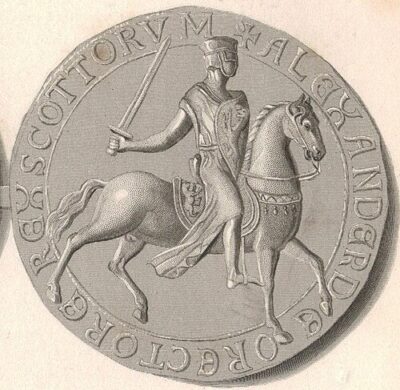
Alexander
Alexander was a King of Alba from 1214 to 1249. Born August 24, 1198, in Haddington. Died July 8, 1249, in Kerrera. Positions held include Monarch of Scotland (1214–1249).
Facts
20 facts · 2 confirmed by two sources · 8 cited · 10 from one source
What’s different
- Died: we show July 8, 1249 (Confirmed). Wikidata also lists July 6, 1249
Where this comes from
Papalocal keeps its own record. It started from these sources; what each one said is kept here as it was copied, so a change on their side never changes this page by itself. Tap one to read its version.
What Wikidata says · copied November 16, 2026 · revision 2567831576
- Described as
- King of Alba from 1214 to 1249
- Other names
- Alexander II
- Born
- August 24, 1198 · 6 references
- Died
- July 8, 1249 · 1 reference; July 6, 1249
- Born in
- Haddington
- Died in
- Kerrera
- Buried in
- Melrose Abbey
- Citizen of
- Kingdom of Scotland
- Occupation
- politician; monarch
- Positions held
- Monarch of Scotland (1214–1249)
- Spouse
- Joan of England (1221–) · 2 references; Marie de Coucy (1239–) · 2 references
- Children
- Alexander III of Scotland · 1 reference; Marjory · 1 reference
- Father
- William the Lion · 1 reference
- Mother
- Ermengarde de Beaumont · 1 reference
- Siblings
- Margaret of Scotland, Countess of Kent · 1 reference; Isabella of Scotland, Countess of Norfolk; Isabella Mac William · 1 reference; Marjorie of Scotland · 1 reference
- Religion
- Christianity
- Wikipedias with a page
- 56
Wikidata item Q237889 (wikidata.org/wiki/Q237889), public domain (CC0). Copied November 16, 2026.
What Wikipedia says · copied November 16, 2026 · revision 1371251036
Alexander II (Medieval Gaelic: Alaxandair mac Uilleim; Modern Gaelic: Alasdair mac Uilleim; 24 August 1198 – 8 July 1249) was King of Scotland from 1214 until his death. He was the son of William the Lion and Ermengarde de Beaumont, succeeding to the throne at the age of sixteen. He ruled for thirty-five years, during which time he began consolidating the Scottish kingdom. Alexander's early reign was marked by conflict with John of England and his involvement in the First Barons' War. He supported the rebel English barons and campaigned mainly in northern England. Following John's death in 1216, Alexander made peace with John's son and successor, Henry III of England, taking a more diplomatic approach between the two kingdoms. This was strengthened by his marriage in 1221 to Joan of England.
Within Scotland, Alexander worked to reinforce his authority across a politically unconsolidated Kingdom. He eliminated repeated rebellions in Ross and Moray in the north and in Galloway in the southwest, including the final destruction of the MacWilliam line. He expanded royal control into regions where his predecessors could only exercise limited influence. Alexander extended his interventions on the western seaboard, confronting Norse-influenced lords in Argyll and the Hebrides. His dealings with England remained central to his rule. In 1237, he concluded the Treaty of York with Henry III, which settled border issues and defined the Anglo-Scottish border in largely enduring terms.
His second marriage, to the French noblewoman Marie de Coucy in 1239, aided Scotland's continental connections. In his later years, Alexander sought to extend his influence in the west, ending in a campaign against Norse possessions in the Hebrides. His intentions were cut short when he died on the island of Kerrera in 1249. He was succeeded by his seven-year-old son, Alexander. Alexander II's reign was important in the development of a more unified and territorially defined Scottish kingdom.
- Born, in its opening lines
- August 24, 1198
- Died, in its opening lines
- July 8, 1249
From the Wikipedia article “Alexander II of Scotland” (en.wikipedia.org/wiki/Alexander_II_of_Scotland), by its contributors, under CC BY-SA 4.0 (creativecommons.org/licenses/by-sa/4.0/). Copied November 16, 2026; not changed.
Confirmed Two sources agree. Cited One source, and it names where it got it. One source One source, without a reference of its own. Sources disagree The sources disagree. We show the best-supported value and keep theirs below.
