
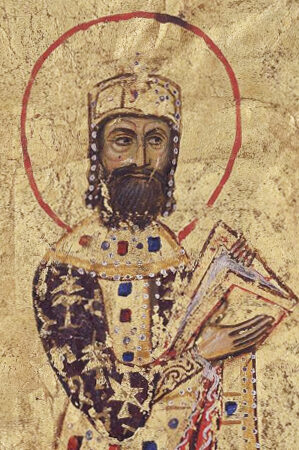
Alexios I Komnenos
Alexios I Komnenos was a Byzantine emperor. Born 1048, in Constantinople. Died August 15, 1118, in Constantinople. Positions held include Byzantine emperor (1081–1118).
Facts
26 facts · 1 confirmed by two sources · 2 cited · 22 from one source · 1 where the sources disagree
What’s different
- Born: we show 1048 (Sources disagree). Wikipedia says c. 1057
Where this comes from
Papalocal keeps its own record. It started from these sources; what each one said is kept here as it was copied, so a change on their side never changes this page by itself. Tap one to read its version.
What Wikidata says · copied November 16, 2026 · revision 2569967575
- Described as
- Byzantine emperor (1048–1118)
- Other names
- Alexius Comnenus, Alexius I Comnenus
- Born
- 1048 · 9 references
- Died
- August 15, 1118 · 1 reference
- Born in
- Constantinople · 1 reference
- Died in
- Constantinople · 2 references
- Cause of death
- disease
- Citizen of
- Byzantine Empire
- Occupation
- emperor · 1 reference
- Positions held
- Byzantine emperor (1081–1118)
- Spouse
- Irene Doukaina (1078–) · 1 reference
- Children
- Anna Komnene · 2 references; Maria Komnene; John II Komnenos; Andronikos Komnenos; Isaac Komnenos · 1 reference; Eudokia Komnene · 1 reference; Theodora Komnene Angelina; Barbara Komnena
- Father
- John Komnenos
- Mother
- Anna Dalassene
- Siblings
- Isaac Komnenos; Adrianos Komnenos; Manuel Komnenos · 1 reference; Nikephoros Komnenos; Theodora Komnene; Maria Komnene; Eudokia Komnene
- Wikipedias with a page
- 71
Wikidata item Q41600 (wikidata.org/wiki/Q41600), public domain (CC0). Copied November 16, 2026.
What Wikipedia says · copied November 16, 2026 · revision 1371797032
Alexios I Komnenos (Greek: Ἀλέξιος Κομνηνός, romanized: Aléxios Komnēnós, c. 1057 – 15 August 1118), Latinized as Alexius I Comnenus, was Byzantine emperor from 1081 to 1118. After usurping the imperial office he was faced with a collapsing empire and constant warfare throughout his reign. Alexios was able to curb the Byzantine decline and begin the military, financial, and territorial recovery known as the Komnenian restoration. His appeals to Western Europe for help against the Seljuk Turks were the catalyst that sparked the First Crusade. Although he was not the first emperor of the Komnenian dynasty, it was during his reign that the Komnenos family came to full power and initiated a hereditary succession to the throne.
The son of John Komnenos and a nephew of Isaac I Komnenos, Alexios served with distinction under three Byzantine emperors. In 1081, he led a rebellion against Emperor Nikephoros III Botaneiates and took the throne for himself. He immediately faced an invasion of the western Balkans by the Normans under Robert Guiscard and his son Bohemond. Despite initial defeats, Alexios secured an alliance with Holy Roman Emperor Henry IV and drove back the Normans, recovering most of Byzantine losses by 1085. In 1091, he achieved a decisive victory over the Pechenegs at the Battle of Levounion in Thrace with the help of Cuman allies.
Later in the 1090s, Alexios directed his attention towards Asia Minor, most of which had fallen to the Seljuk Turks. Desiring western support, he took reconciliatory measures towards the Papacy, and in 1095 his envoys made a formal appeal to Pope Urban II at the Council of Piacenza. At the subsequent Council of Clermont, Pope Urban formally called the First Crusade, which began a year after and concluded with much of western Anatolia restored to Byzantine rule. On Alexios's death in 1118, he was succeeded by his son John II Komnenos. Alexios's reign and campaigns were recorded by his daughter Anna Komnene in her Alexiad, a political and military history, which she named after her father.
- Born, in its opening lines
- c. 1057
- Died, in its opening lines
- August 15, 1118
From the Wikipedia article “Alexios I Komnenos” (en.wikipedia.org/wiki/Alexios_I_Komnenos), by its contributors, under CC BY-SA 4.0 (creativecommons.org/licenses/by-sa/4.0/). Copied November 16, 2026; not changed.
Confirmed Two sources agree. Cited One source, and it names where it got it. One source One source, without a reference of its own. Sources disagree The sources disagree. We show the best-supported value and keep theirs below.
