
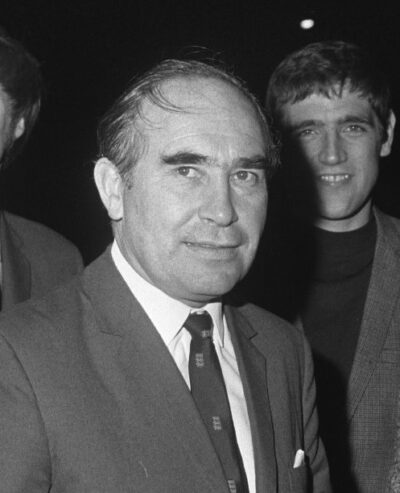
Alf Ramsey
Alf Ramsey was an English association football player and manager. Born January 22, 1920, in Dagenham. Died April 28, 1999, in Ipswich. Teams include Southampton F.C. (1943–1949), Tottenham Hotspur F.C. (1949–1955) and Portsmouth F.C.. Awards include Knight Bachelor.
Facts
22 facts · 2 confirmed by two sources · 4 cited · 16 from one source
Where this comes from
Papalocal keeps its own record. It started from these sources; what each one said is kept here as it was copied, so a change on their side never changes this page by itself. Tap one to read its version.
What Wikidata says · copied November 16, 2026 · revision 2557651944
- Described as
- English association football player and manager (1920-1999)
- Other names
- Alfred Ernest Ramsey, Sir Alf Ramsey
- Born
- January 22, 1920 · 4 references
- Died
- April 28, 1999 · 3 references
- Born in
- Dagenham
- Died in
- Ipswich · 2 references
- Buried in
- Old Ipswich Cemetery · 1 reference
- Cause of death
- myocardial infarction
- Name at birth
- Alfred Ernest Ramsey
- Citizen of
- United Kingdom
- Occupation
- association football player · 1 reference; association football coach · 1 reference
- Worked for
- Ipswich Town F.C.; The Football Association; Birmingham City F.C.; Panathinaikos F.C.
- Teams
- Southampton F.C. (1943–1949); Tottenham Hotspur F.C. (1949–1955); Portsmouth F.C.; England national association football B team (1948); England men's national association football team (1948–1953)
- Sport
- association football
- Awards
- Knight Bachelor
- Height
- 1.73 m (5 ft 8 in)
- Wikipedias with a page
- 47
Wikidata item Q311029 (wikidata.org/wiki/Q311029), public domain (CC0). Copied November 16, 2026.
What Wikipedia says · copied November 16, 2026 · revision 1381382771
Sir Alfred Ernest Ramsey (22 January 1920 – 28 April 1999) was an English football player and manager. As a player, he represented the England national team and captained the side, but he is best known for his time as England manager from 1963 to 1974, which included guiding them to victory in the 1966 FIFA World Cup. Knighted in 1967 in recognition of the World Cup win, Ramsey also managed his country to third place in the 1968 European Championship and the quarter-finals of the 1970 World Cup and the 1972 European Championship. As a player, Ramsey was a defender and a member of England's 1950 World Cup squad.
Ramsey was born and raised in a quiet Essex village. He showed sporting promise from an early age and, after serving in the British Army during the Second World War, embarked on a football career, primarily as a right-back. He was considered a rather slow but accomplished player with a tremendous grasp of the tactical side of the game. Nicknamed "The General", he played for England 32 times between 1948 and 1953, captaining the side three times, scoring three times and appearing in the 1950 World Cup. He played his club football for Southampton and Tottenham Hotspur and was part of the Tottenham side that won the English League championship in the 1950–51 season.
Ramsey retired from playing aged 35 to become the manager of Ipswich Town, then in the third tier of English football. Ipswich rose through the divisions over the next six years, winning the Third Division South in 1956–57 and the Second Division in 1960–61. In the 1961–62 season, Ipswich's first campaign in the top division, Ramsey's team defied expectations to become champions of England. Ramsey took charge of the England team a year later. In a distinct break with common practice of the day, he used a narrow formation that led to his England side being dubbed "The Wingless Wonders". England's World Cup victory at Wembley in 1966 made Ramsey a national hero, though he had his critics, both at the time and since. He lost the England job acrimoniously, following the team's failure to qualify for the 1974 World Cup.
After managing England, Ramsey briefly held football-related roles at Birmingham City and Panathinaikos, before retiring in 1979–80. He led a somewhat reclusive life in Ipswich over the next two decades and died in 1999, aged 79. A statue of Ramsey was dedicated at the reconstructed Wembley Stadium in 2009, and various honours have been afforded to him in Ipswich. He is the first person to have been inducted into the English Football Hall of Fame twice: an inaugural inductee in 2002, in recognition of his achievements as a manager, and admitted again in 2010 for his achievements as a player. He remains widely regarded as one of British football's greatest ever managers. In 2022, FourFourTwo ranked him at No. 26 on its list of the Top 100 football managers of all time.
- Born, in its opening lines
- January 22, 1920
- Died, in its opening lines
- April 28, 1999
From the Wikipedia article “Alf Ramsey” (en.wikipedia.org/wiki/Alf_Ramsey), by its contributors, under CC BY-SA 4.0 (creativecommons.org/licenses/by-sa/4.0/). Copied November 16, 2026; not changed.
Confirmed Two sources agree. Cited One source, and it names where it got it. One source One source, without a reference of its own. Sources disagree The sources disagree. We show the best-supported value and keep theirs below.
