
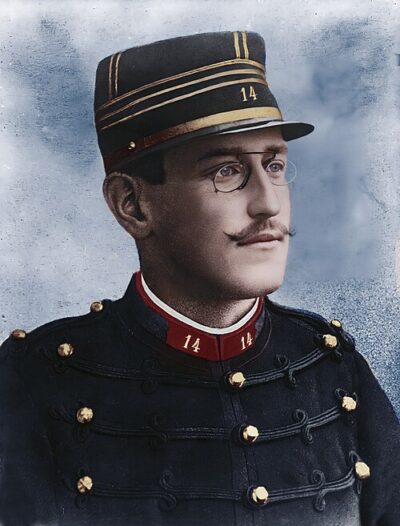
Alfred Dreyfus
Alfred Dreyfus was a French artillery officer. Born October 9, 1859, in Mulhouse. Died July 12, 1935, in Paris. Educated at École polytechnique and École supérieure de guerre. Awards include Croix de guerre 1914–1918, Officer of the Legion of Honour and Knight of the Legion of Honour.
Facts
27 facts · 2 confirmed by two sources · 5 cited · 20 from one source
Where this comes from
Papalocal keeps its own record. It started from these sources; what each one said is kept here as it was copied, so a change on their side never changes this page by itself. Tap one to read its version.
What Wikidata says · copied November 16, 2026 · revision 2568733058
- Described as
- French artillery officer (1859–1935)
- Other names
- Dreyfus
- Born
- October 9, 1859 · 10 references
- Died
- July 12, 1935 · 8 references
- Born in
- Mulhouse · 1 reference
- Died in
- Paris · 3 references
- Buried in
- Montparnasse Cemetery
- Cause of death
- myocardial infarction
- Citizen of
- France · 1 reference
- Occupation
- army officer; military officer · 1 reference
- Education
- École polytechnique; École supérieure de guerre (1890–); Lycée Chaptal; Collège Sainte-Barbe
- Awards
- Croix de guerre 1914–1918; Officer of the Legion of Honour (1919–) · 1 reference; Knight of the Legion of Honour (1906–) · 1 reference; Médaille commémorative de la guerre 1914–1918
- Spouse
- Lucie Dreyfus · 1 reference
- Children
- Pierre Dreyfus; Jeanne Lévy
- Siblings
- Mathieu Dreyfus; Jacques Dreyfus
- Religion
- Judaism
- Military branch
- artillery branch
- Military rank
- chef d'escadron (1906–1907); brigadier general (2025–); capitaine (1889–1895)
- Wikipedias with a page
- 72
Wikidata item Q171826 (wikidata.org/wiki/Q171826), public domain (CC0). Copied November 16, 2026.
What Wikipedia says · copied November 16, 2026 · revision 1385067671
Alfred Dreyfus (9 October 1859 – 12 July 1935) was a French Army officer best known for his central role in the Dreyfus affair. In 1894, Dreyfus fell victim to a judicial conspiracy that eventually sparked a major political crisis in the French Third Republic when he was wrongfully accused and convicted of being a German spy due to antisemitism. Dreyfus was arrested, cashiered from the French army and imprisoned on Devil's Island in French Guiana. Eventually, evidence emerged showing that Dreyfus was innocent and the true culprit was fellow officer Ferdinand Walsin Esterhazy.
Gradual revelations indicated that the internal investigation conducted by the French army was biased; Dreyfus was an ideal scapegoat due to being a Jew, and military authorities were aware of his innocence but chose to cover up the affair and leave him imprisoned rather than lose face. A political scandal subsequently erupted, shaking French political life and highlighting antisemitism in the French army and government. After numerous judicial and political developments, the publication of Émile Zola's manifesto J'Accuse...! in 1898 brought new momentum to Dreyfus' cause. Zola accused French military and political leadership of covering up the affair. Dreyfus was eventually exonerated, rehabilitated and reinstated in the French army, although at a lower rank than his seniority would have warranted.
"Anti-Dreyfusards" and antisemites in France, however, viewed even his rehabilitation unfavorably, and while attending the transfer of Zola's remains to the Panthéon, Dreyfus was the target of an unsuccessful assassination attempt by an antisemitic militarist who was later acquitted at trial. Dreyfus later fought in World War I, notably at the battles of Verdun and the Aisne, before retiring and leading a quiet life. He died in 1935 in Paris and was buried in the Montparnasse Cemetery. Dreyfus' life and the antisemitic persecutions he endured left a significant mark on French political consciousness, while Esterhazy remained unpunished until his death. Among Dreyfus's defenders were writers such as Zola, Charles Péguy, and Anatole France, politicians such as Georges Clemenceau and Jean Jaurès, filmmakers such as Georges Méliès, and the founders of the Human Rights League (LDH) Francis de Pressensé and Pierre Quillard.
- Born, in its opening lines
- October 9, 1859
- Died, in its opening lines
- July 12, 1935
From the Wikipedia article “Alfred Dreyfus” (en.wikipedia.org/wiki/Alfred_Dreyfus), by its contributors, under CC BY-SA 4.0 (creativecommons.org/licenses/by-sa/4.0/). Copied November 16, 2026; not changed.
Confirmed Two sources agree. Cited One source, and it names where it got it. One source One source, without a reference of its own. Sources disagree The sources disagree. We show the best-supported value and keep theirs below.
