
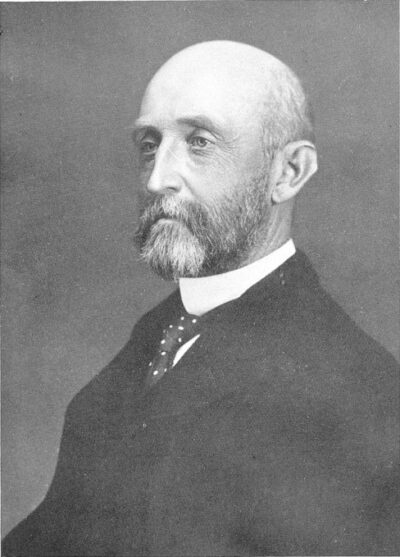
Alfred Thayer Maan
Alfred Thayer Maan was an United States Navy admiral and historian. Born September 27, 1840, in West Point. Died December 1, 1914, in Washington, D.C.. Educated at Columbia University and United States Naval Academy. Awards include honorary doctorate from the McGill University.
Facts
32 facts · 2 confirmed by two sources · 7 cited · 23 from one source
Where this comes from
Papalocal keeps its own record. It started from these sources; what each one said is kept here as it was copied, so a change on their side never changes this page by itself. Tap one to read its version.
What Wikidata says · copied November 13, 2026 · revision 2557700788
- Described as
- United States Navy admiral and historian (1840–1914)
- Other names
- Admiral Alfred Thayer Mahan, A. T. Mahan, Alfred Mahan, Alfred T. Mahan
- Born
- September 27, 1840 · 7 references
- Died
- December 1, 1914 · 7 references
- Born in
- West Point · 2 references
- Died in
- Washington, D.C. · 1 reference
- Buried in
- Quogue Cemetery · 1 reference
- Citizen of
- United States
- Occupation
- military officer; geopolitical analyst; military historian; historian; political scientist; writer · 1 reference; naval officer · 1 reference; author · 1 reference
- Worked for
- Naval War College
- Education
- Columbia University; United States Naval Academy · 1 reference; St. James School · 1 reference
- Member of
- American Academy of Arts and Sciences; American Historical Association; American Academy of Arts and Letters
- Awards
- honorary doctorate from the McGill University
- Field
- international relations
- Spouse
- Ellen Lyle Evans
- Children
- Alfred Thayer Mahan · 1 reference
- Father
- Dennis Hart Mahan
- Religion
- Episcopal Church
- Military branch
- United States Navy; Union Navy
- Military rank
- rear admiral (1906–); midshipman (1859–); lieutenant (1861–)
- Wikipedias with a page
- 43
Wikidata item Q142988 (wikidata.org/wiki/Q142988), public domain (CC0). Copied November 13, 2026.
What Wikipedia says · copied November 13, 2026 · revision 1384366808
Alfred Thayer Mahan (; September 27, 1840 – December 1, 1914) was the United States Navy (USN) officer and historian whom John Keegan called "the most important American strategist of the nineteenth century." His 1890 book The Influence of Sea Power upon History, 1660–1783 won immediate recognition, especially in Europe, and with the publication of its 1892 successor, The Influence of Sea Power upon the French Revolution and Empire, 1793–1812, he affirmed his status as a globally-known and regarded military strategist, historian, and theorist. Mahan's works encouraged the development of large capital ships—eventually leading to dreadnought battleships—as he was an advocate of the 'decisive battle' and of naval blockades.
Critics, however, charged him with failing to adequately explain the rise of largely land-based empires, such as the German or Ottoman Empires, though Mahan did accurately predict both empires' defeats in World War I. Mahan directly influenced the dominant interwar period and World War II-era Japanese naval doctrine of the "decisive battle doctrine" (艦隊決戦, Kantai Kessen), and he became a "household name" in Germany. He also promoted American control over Hawaii though he was "lukewarm" in regard to American imperialism in general. The USN's Mahan-class of destroyers served as his namesake, four individual USN ships have borne his name, as well as various buildings and roads.
Mahan has been described as "America's first globalist" and the United States Naval Institute has described his scholarship as "foundational to all systematic study of naval power". Strategies and ideas which view Mahan's works as key are sometimes referred to as "Mahanian", with adherents referred to as "Mahanians".
- Born, in its opening lines
- September 27, 1840
- Died, in its opening lines
- December 1, 1914
From the Wikipedia article “Alfred Thayer Mahan” (en.wikipedia.org/wiki/Alfred_Thayer_Mahan), by its contributors, under CC BY-SA 4.0 (creativecommons.org/licenses/by-sa/4.0/). Copied November 13, 2026; not changed.
Confirmed Two sources agree. Cited One source, and it names where it got it. One source One source, without a reference of its own. Sources disagree The sources disagree. We show the best-supported value and keep theirs below.
