
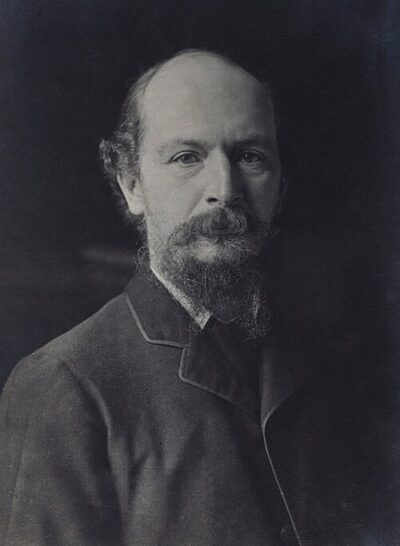
Algernon Charles Swinburne
Algernon Charles Swinburne was an English poet, playwright and novelist. Born April 5, 1837, in London. Died April 10, 1909, in Putney. Known for Atalanta in Calydon and Poems and Ballads. Educated at Eton College and Balliol College.
Facts
16 facts · 2 confirmed by two sources · 6 cited · 8 from one source
Where this comes from
Papalocal keeps its own record. It started from these sources; what each one said is kept here as it was copied, so a change on their side never changes this page by itself. Tap one to read its version.
What Wikidata says · copied November 16, 2026 · revision 2567321598
- Described as
- English poet, playwright and novelist (1837–1909)
- Other names
- Algernon Charles Swiburne, Algernon Swinburne
- Born
- April 5, 1837 · 17 references
- Died
- April 10, 1909 · 18 references
- Born in
- London · 3 references
- Died in
- Putney · 1 reference
- Buried in
- St Boniface Church, Bonchurch · 1 reference
- Cause of death
- influenza
- Citizen of
- United Kingdom of Great Britain and Ireland
- Occupation
- poet · 3 references; writer · 1 reference; literary critic · 1 reference
- Education
- Eton College; Balliol College
- Known for
- Atalanta in Calydon; Poems and Ballads
- Father
- Charles Henry Swinburne · 1 reference
- Mother
- Jane Ashburnham · 2 references
- Wikipedias with a page
- 61
Wikidata item Q315511 (wikidata.org/wiki/Q315511), public domain (CC0). Copied November 16, 2026.
What Wikipedia says · copied November 16, 2026 · revision 1371331549
Algernon Charles Swinburne (5 April 1837 – 10 April 1909) was an English poet, playwright, novelist, and critic. He was a major contributor to the Pre-Raphaelite movement in poetry, along with Dante Gabriel Rossetti and William Morris. His greatest works are the verse drama Atalanta in Calydon (1865), written in the form of an Ancient Greek tragedy, and his Pre-Raphaelite Poems and Ballads (1866).
In his poetry, Swinburne rebelled against the Christian morality of the Victorian era, drawing from classical, medieval, and Renaissance sources to explore atheism in "Hymn to Proserpine", suicide in "The Triumph of Time", lesbian desire in "Anactoria", and sado-masochism in "Dolores". While Swinburne's work attracted scandal, it had prominent Victorian defenders, including John Ruskin.
Swinburne's poetic style is rhythmic, alliterative, and sensual, and drew both critical acclaim and moral condemnation in his lifetime. His poems are often complex, working double rhymes and anapaestic metre into intricate stanzas. Swinburne's style was shaped by that of the French poet Charles Baudelaire, author of the notorious Les Fleurs du mal, for whom Swinburne wrote the poetic eulogy "Ave Atque Vale".
Swinburne was nominated for the Nobel Prize in Literature every year from 1903 to 1909. After the death of Alfred, Lord Tennyson in 1892, Swinburne was considered for the post of Poet Laureate of the United Kingdom, but was disqualified by Queen Victoria on moral grounds. His writings influenced Aesthetic and Decadent poets of the fin de siècle, such as Oscar Wilde and Ernest Dowson.
- Born, in its opening lines
- April 5, 1837
- Died, in its opening lines
- April 10, 1909
From the Wikipedia article “Algernon Charles Swinburne” (en.wikipedia.org/wiki/Algernon_Charles_Swinburne), by its contributors, under CC BY-SA 4.0 (creativecommons.org/licenses/by-sa/4.0/). Copied November 16, 2026; not changed.
Confirmed Two sources agree. Cited One source, and it names where it got it. One source One source, without a reference of its own. Sources disagree The sources disagree. We show the best-supported value and keep theirs below.
