
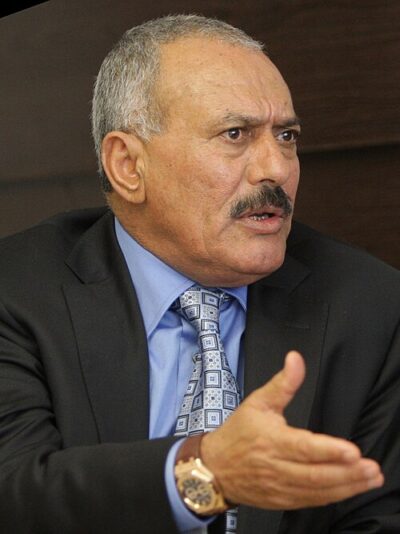
Ali Abdullah Saleh
Ali Abdullah Saleh was a President of North Yemen (1978–1990) and Yemen. Born March 21, 1947, in Sanhan. Died December 4, 2017, in Sanaa. Positions held include President of Yemen Arab Republic (1978–1990) and President of Yemen (1990–2012). Awards include Order of José Martí, Golden Key of Madrid and Order of Unity.
Facts
35 facts · 2 confirmed by two sources · 4 cited · 29 from one source
Where this comes from
Papalocal keeps its own record. It started from these sources; what each one said is kept here as it was copied, so a change on their side never changes this page by itself. Tap one to read its version.
What Wikidata says · copied November 16, 2026 · revision 2563043491
- Described as
- President of North Yemen (1978–1990) and Yemen (1990–2012)
- Other names
- Ali Abdullah Saleh al-Ahmar, Affash
- Born
- March 21, 1947 · 1 reference
- Died
- December 4, 2017 · 2 references
- Born in
- Sanhan
- Died in
- Sanaa
- Buried in
- Sanaa
- Cause of death
- gunshot wound
- Citizen of
- Yemen · 2 references
- Occupation
- politician · 1 reference; military personnel
- Positions held
- President of Yemen Arab Republic (1978–1990); President of Yemen (1990–2012)
- Political party
- General People's Congress (1982–2017)
- Awards
- Order of José Martí; Golden Key of Madrid (2008) · 1 reference; Order of Unity · 1 reference; Royal Order of Francis I · 1 reference; Order of Zayed · 1 reference; Order of the Grand Conqueror · 1 reference; Order of the 7th November 1987 · 1 reference; Order of the Liberator · 1 reference
- Spouse
- Asma Saledp
- Children
- Ahmed Saleh; Khaled Ali Abdullah Saleh; Sakhr Ali Abdullah Saleh; Ridan Ali Abdullah Saleh; Madeen Ali Abdullah Saleh; Salah Ali Abdullah Saleh
- Father
- Abdallah Saleh Afaash
- Siblings
- Mohammed Abdullah Saleh · 1 reference; Saleh Abdullah Saleh Al-Ahmar; Ali Saleh Al-Ahmar; Mohammed Saleh Al-Ahmar
- Military branch
- Republic of Yemen Armed Forces · 1 reference
- Military rank
- field marshal (–2012); marshal
- Wikipedias with a page
- 86
Wikidata item Q483672 (wikidata.org/wiki/Q483672), public domain (CC0). Copied November 16, 2026.
What Wikipedia says · copied November 16, 2026 · revision 1380446055
Ali Abdullah Saleh (21 March 1947 – 4 December 2017) was a Yemeni military officer and politician who served as the first president of the Republic of Yemen from the Yemeni unification in 1990 until his resignation in 2012, following the Yemeni revolution. Previously, he had served as the fifth and last President of the Yemen Arab Republic (North Yemen), from July 1978 to 22 May 1990, after the assassination of President Ahmad al-Ghashmi. al-Ghashmi had earlier appointed Saleh as military governor in Taiz.
A veteran and officer of the North Yemen civil war, Saleh consolidated power and restored civilian rule after al-Ghashmi's assassination in 1978. Despite military defeat against South Yemen in the Second Yemenite War, a rebellion, and multiple coup attempts, Saleh, though challenged with stagnant economic growth and significant poverty, had managed to bring stability to North Yemen by the mid 1980's, and enjoyed support from both the United States and the Soviet Union. After South Yemen had become unstable following the 1986 crisis and the fall of communism, Saleh achieved reunification as President of the new Republic of Yemen, sharing power in tandem with South Yemen's last leader and transitional Vice President Ali Salem al-Beidh, prominent general Mohsen al-Ahmar and tribal Sheikh and leader of the Islamist Islah movement, Abdullah al-Ahmar, through a Presidential Council. Due to apparent North–South divisions, al-Beidh left the Council in 1993, and in the brief civil war that followed, Saleh's forces, assisted by jihadists such as the Egyptian Islamic Jihad, roundly defeated Southern forces in July 1994.
From 1994 onward, Saleh returned to autocratic rule through rule by decree, and was confirmed by elections in 1999, 2006, and a controversial constitutional referendum in 2001. Until 2011, he presided over stable economic growth and an insurgency by the Ansar Allah movement, commonly known as the Houthis.
As President of unified Yemen, Saleh and the Presidential Council alienated the US and Saudi governments by expressing opposition to the Gulf War, which prompted an exodus of over 800,000 Yemenis from Saudi Arabia, but after Saleh consolidated absolute power, he developed deeper ties with Western powers, especially the United States, during the war on terror. Subsequently, evidence emerged that Islamic terrorism may have been used and encouraged by Saleh in order to win Western support and for disruptive politically motivated attacks. In 2011, in the wake of the Arab Spring, which spread across North Africa and the Middle East (including Yemen), Saleh's time in office became increasingly precarious, culminating in his final resignation from the presidency in 2012. He was succeeded by Abdrabbuh Mansur Hadi, who had been serving as vice president since 1994, and acting president since 2011, and who was elected president in the 2012 Yemeni presidential election.
Himself a Zaydi Shia Muslim, Saleh openly allied with the Houthis in May 2015 during the Yemeni civil war, in which a protest movement and subsequent insurgency succeeded in capturing Yemen's capital, Sanaa, forcing President Hadi to resign and later flee to Aden, where he withdrew his resignation and denounced the Houthi takeover as illegitimate. In December 2017, he declared his withdrawal from his coalition with the Houthis and instead sided with his former enemies – Saudi Arabia, the United Arab Emirates and President al-Hadi.
On 4 December 2017, during a battle between Houthi and Saleh supporters in Sanaa, the Houthis accused Saleh of treason, and he was killed by a Houthi sniper. Reports were that Saleh was killed while trying to flee his compound in a car; however, this was denied by his party officials, who said he was killed at his house.
- Born, in its opening lines
- March 21, 1947
- Died, in its opening lines
- December 4, 2017
From the Wikipedia article “Ali Abdullah Saleh” (en.wikipedia.org/wiki/Ali_Abdullah_Saleh), by its contributors, under CC BY-SA 4.0 (creativecommons.org/licenses/by-sa/4.0/). Copied November 16, 2026; not changed.
Confirmed Two sources agree. Cited One source, and it names where it got it. One source One source, without a reference of its own. Sources disagree The sources disagree. We show the best-supported value and keep theirs below.
