
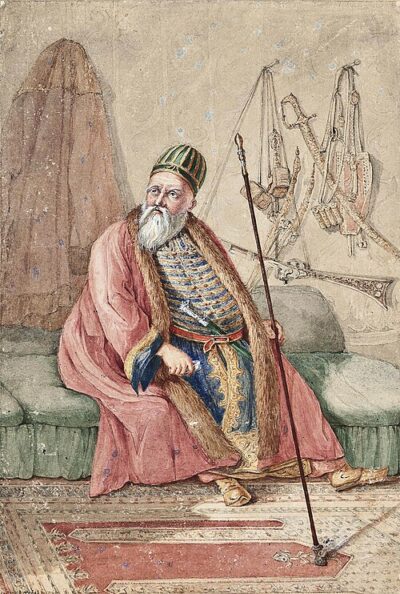
Ali Pasha
Ali Pasha was an Albanian ruler. Born 1741, in Tepelena. Died February 5, 1822, in Ioannina Island.
Facts
14 facts · 0 confirmed by two sources · 0 cited · 12 from one source · 2 where the sources disagree
What’s different
- Born: we show 1741 (Sources disagree). Wikidata also lists 1750
- Died: we show February 5, 1822 (Sources disagree). Wikipedia says January 24, 1822
Where this comes from
Papalocal keeps its own record. It started from these sources; what each one said is kept here as it was copied, so a change on their side never changes this page by itself. Tap one to read its version.
What Wikidata says · copied November 16, 2026 · revision 2570299990
- Described as
- Albanian ruler (1740–1822)
- Other names
- Ali Pasha of Janina, Ali Pasha of Ioannina, Ali Pasha of Tepelena, Ali Pasha of Yannina, Ali the Lion
- Born
- 1750; 1741 · 1 reference
- Died
- February 5, 1822
- Born in
- Tepelena
- Died in
- Ioannina Island
- Buried in
- Fethiye Mosque
- Cause of death
- gunshot wound
- Citizen of
- Ottoman Empire
- Occupation
- politician
- Spouse
- Kyra Vassiliki
- Children
- Veli Pasha; Muhtar Pasha; Salih Pasha
- Mother
- Hamko
- Religion
- Islam
- Wikipedias with a page
- 43
Wikidata item Q297285 (wikidata.org/wiki/Q297285), public domain (CC0). Copied November 16, 2026.
What Wikipedia says · copied November 16, 2026 · revision 1376515253
Ali Pasha (1743 – 24 January 1822), commonly known as Ali Pasha of Yanina or Ali Pasha of Tepelena, was an Albanian ruler who served as pasha of the Pashalik of Yanina, a large part of western Rumelia, in the Ottoman Empire. Under his rule, it acquired a high degree of autonomy and even managed to stay de facto independent. The capital of the Pashalik was Ioannina, which, along with Tepelena, was Ali's headquarters.
Conceiving his territory in increasingly independent terms, Ali Pasha's correspondence and foreign Western correspondence frequently refer to the territories under Ali's control as "Albania". This, by Ali's definition, included central and southern Albania, and parts of mainland Greece; in particular, most of the district of Epirus and the western parts of Thessaly and Macedonia. He managed to stretch his control over the sanjaks of Yanina, Delvina, Vlora and Berat, Elbasan, Ohrid and Monastir, Görice, and Tirhala. Ali was granted the Sanjak of Tirhala in 1787, and he delegated its government in 1788 to his second-born Veli Pasha, who also became Pasha of the Morea Eyalet in 1807. Ali's eldest son, Muhtar Pasha, was granted the Sanjak of Karli-Eli and the Sanjak of Eğriboz in 1792, stretching for the first time Ali's control down to Livadia and the Gulf of Corinth, except Attica. Muhtar Pasha also became governor of the Sanjak of Ohrid in 1796–7 and of the Sanjak of Vlora and Berat in 1810.
Ali first appears in historical accounts as the leader of a band of Albanian brigands who became involved in many confrontations with Ottoman state officials in Albania and Epirus. He joined the administrative-military apparatus of the Ottoman Empire, holding various posts until 1788, when he was appointed pasha, ruler of the Sanjak of Ioannina. His diplomatic and administrative skills, his interest in modern ideas and concepts, his popular Muslim piety, his respect towards other religions, his suppression of banditry, his vengefulness and harshness in imposing law and order, and his looting practices towards persons and communities in order to increase his profits caused both the admiration and the criticism by his contemporaries, as well as an ongoing controversy among historians regarding his personality. As his influence grew, his involvement in Ottoman politics increased culminating in his active opposition to the ongoing Ottoman military reforms. He was one of the most prominent leaders in the Ottoman Empire. After being declared a rebel in 1820, he was captured and killed in 1822 at the age of 78 or 79, after a successful military campaign of the Porte against his Albanian rebel forces. The initial Greek uprising in the Morea on the eve of the Greek Revolution in 1821 began as an extension of Ali Pasha's revolt in Albania.
- Born, in its opening lines
- 1743
- Died, in its opening lines
- January 24, 1822
From the Wikipedia article “Ali Pasha of Yanina” (en.wikipedia.org/wiki/Ali_Pasha_of_Yanina), by its contributors, under CC BY-SA 4.0 (creativecommons.org/licenses/by-sa/4.0/). Copied November 16, 2026; not changed.
Confirmed Two sources agree. Cited One source, and it names where it got it. One source One source, without a reference of its own. Sources disagree The sources disagree. We show the best-supported value and keep theirs below.
