
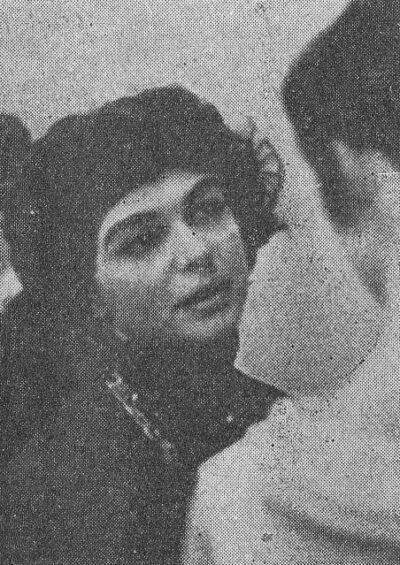
Alina Szapocznikow
Alina Szapocznikow was a Polish sculptor. Born May 16, 1926, in Kalisz. Died March 2, 1973, in Praz-Coutant. Awards include Gold Cross of Merit and Medal of the 10th Anniversary of People's Poland.
Facts
16 facts · 2 confirmed by two sources · 6 cited · 8 from one source
Where this comes from
Papalocal keeps its own record. It started from these sources; what each one said is kept here as it was copied, so a change on their side never changes this page by itself. Tap one to read its version.
What Wikidata says · copied November 18, 2026 · revision 2570302748
- Described as
- Polish sculptor (1926–1973)
- Born
- May 16, 1926 · 5 references
- Died
- March 2, 1973 · 5 references
- Born in
- Kalisz · 3 references
- Died in
- Praz-Coutant
- Buried in
- Montmartre Cemetery
- Cause of death
- breast cancer
- Citizen of
- Poland · 4 references; France · 1 reference
- Occupation
- sculptor · 3 references; artist · 2 references; draftsperson · 1 reference; photographer · 1 reference; graphic artist · 1 reference
- Genre
- abstract art
- Awards
- Gold Cross of Merit; Medal of the 10th Anniversary of People's Poland
- Wikipedias with a page
- 24
Wikidata item Q466550 (wikidata.org/wiki/Q466550), public domain (CC0). Copied November 18, 2026.
What Wikipedia says · copied November 18, 2026 · revision 1385727189
Alina Szapocznikow (Polish: [ʂapɔt͡ʂˈɲikɔf]; 16 May 1926 – 2 March 1973) was a Polish artist and Holocaust survivor. Recognized as one of the most important Polish sculptors of the post-war era, Szapocznikow utilized diverse and experimental mediums to investigate and examine the human form, recalling genres such as surrealism, nouveau realism, and pop art.
Born in 1926 in Kalisz, Poland, into a Jewish family, she grew up in Pabianice near Łódź. Her childhood was disrupted by the outbreak of World War II. Szapocznikow was later imprisoned in the Nazi concentration camps at Auschwitz and Bergen-Belsen before being transferred to Terezin in 1943. After the end of the war in 1945, Szapocznikow moved to Prague, where she began her formal training in sculpture. Her education continued at the École nationale supérieure des Beaux-Arts in Paris, under Paul Niclausse. During the late 1940s and early 1950s, she moved between Prague and Paris, and later became ill with peritoneal tuberculosis.
In 1952, Szapocznikow married Polish art historian Ryszard Stanisławski, but the marriage ended in 1958. She participated in numerous competitions for public monuments conforming to the doctrine of Socialist Realism in Soviet-aligned Poland. After the Khrushchev Thaw, Szapocznikow returned to avant-garde works, focusing on the subject of her own body, a theme that would remain central to her work throughout the rest of her artistic career. In 1962, she was offered a solo show at the Venice Biennale and moved to Paris in 1963, where she became friends with Pierre Restany and experimented with innovative materials and techniques in sculpture. Szapocznikow died in March 1973 of bone cancer. After the fall of communism in Poland, her work gained recognition domestically and abroad, including a major retrospective at the Museum of Modern Art in New York in 2013.
- Born, in its opening lines
- May 16, 1926
- Died, in its opening lines
- March 2, 1973
From the Wikipedia article “Alina Szapocznikow” (en.wikipedia.org/wiki/Alina_Szapocznikow), by its contributors, under CC BY-SA 4.0 (creativecommons.org/licenses/by-sa/4.0/). Copied November 18, 2026; not changed.
Confirmed Two sources agree. Cited One source, and it names where it got it. One source One source, without a reference of its own. Sources disagree The sources disagree. We show the best-supported value and keep theirs below.
