
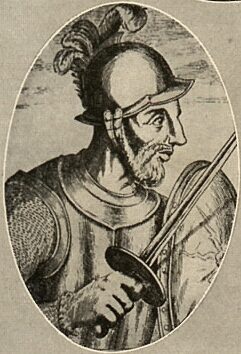
Alonso de Ojeda
Alonso de Ojeda was a Spanish navigator and governor. Born 1466, in Torrejoncillo del Rey. Died 1515, in Santo Domingo.
Facts
12 facts · 0 confirmed by two sources · 6 cited · 6 from one source
Where this comes from
Papalocal keeps its own record. It started from these sources; what each one said is kept here as it was copied, so a change on their side never changes this page by itself. Tap one to read its version.
What Wikidata says · copied November 16, 2026 · revision 2557722423
- Described as
- Spanish navigator and governor
- Other names
- Alonso de Hojeda, Alfonso de Ojeda, Alonzo de Hojeda
- Born
- 1466 · 2 references
- Died
- 1515 · 3 references
- Born in
- Torrejoncillo del Rey · 1 reference
- Died in
- Santo Domingo · 1 reference
- Buried in
- Dominican National Pantheon
- Citizen of
- Crown of Castile
- Occupation
- explorer; conquistador; governor; seafarer · 1 reference; discoverer · 1 reference
- Member of
- Columbus conquistador force
- Wikipedias with a page
- 40
Wikidata item Q313369 (wikidata.org/wiki/Q313369), public domain (CC0). Copied November 16, 2026.
What Wikipedia says · copied November 16, 2026 · revision 1347593966
Alonso de Ojeda (Spanish pronunciation: [aˈlonso ðe oˈxeða]; c. 1466 – c. 1515) was a Spanish explorer, governor and conquistador. He is famous for having named Venezuela, which he explored during his first two expeditions, for having been the first European to visit Guyana, Curaçao, Colombia (La Guajira) and Lake Maracaibo, and later for founding Santa Cruz (La Guairita). He also travelled to Trinidad, Tobago and Aruba, in some of his travels he journeyed with Amerigo Vespucci and Juan de la Cosa.
Ojeda was part of the first wave of Spanish conquistadors in the Americas.
From the Wikipedia article “Alonso de Ojeda” (en.wikipedia.org/wiki/Alonso_de_Ojeda), by its contributors, under CC BY-SA 4.0 (creativecommons.org/licenses/by-sa/4.0/). Copied November 16, 2026; not changed.
Confirmed Two sources agree. Cited One source, and it names where it got it. One source One source, without a reference of its own. Sources disagree The sources disagree. We show the best-supported value and keep theirs below.
