
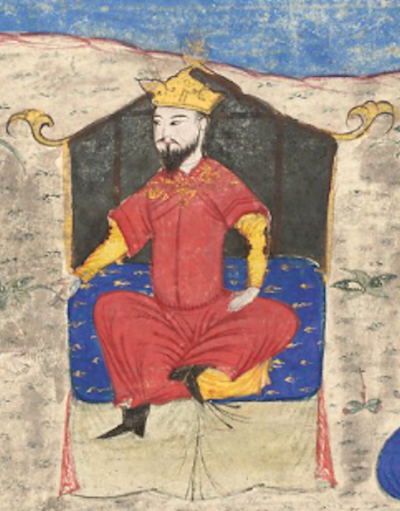
Alp Arslan
Alp Arslan was a second sultan of the Seljuk Empire. Born January 20, 1029. Died December 15, 1072, in Barzam Fortress. Positions held include Sultan of the Seljuq Empire (1063–1072).
Facts
22 facts · 1 confirmed by two sources · 1 cited · 19 from one source · 1 where the sources disagree
What’s different
- Born: we show January 20, 1029 (Confirmed). Wikidata also lists 1030
- Died: we show December 15, 1072 (Sources disagree). Wikipedia says November 24, 1072
Where this comes from
Papalocal keeps its own record. It started from these sources; what each one said is kept here as it was copied, so a change on their side never changes this page by itself. Tap one to read its version.
What Wikidata says · copied November 16, 2026 · revision 2568102399
- Described as
- second sultan of the Seljuk Empire (1063–1072)
- Other names
- Abu Shuca Alparslan
- Born
- January 20, 1029; 1030 · 1 reference
- Died
- December 15, 1072
- Died in
- Barzam Fortress
- Buried in
- Merv
- Cause of death
- stab wound
- Citizen of
- Seljuk Empire
- Occupation
- military leader
- Positions held
- Sultan of the Seljuq Empire (1063–1072)
- Spouse
- Seferiye Hatun; Akça Hatun
- Children
- Malik-Shah I; Tutush I; Toghan-Shah (son of Alp Arslan); Arslan Arghun; Buri Bars; Sifri Khatun; Aysha Khatun
- Father
- Chaghri Beg · 1 reference
- Siblings
- Qavurt; Yaquti
- Religion
- Sunni Islam; Islam
- Wikipedias with a page
- 67
Wikidata item Q200193 (wikidata.org/wiki/Q200193), public domain (CC0). Copied November 16, 2026.
What Wikipedia says · copied November 16, 2026 · revision 1385310635
Alp Arslan (Persian: آلپ ارسلان; full name: Muhammad Alp Arslan bin Dawud Chaghri) (20 January 1029 – 24 November 1072) was the son of Chaghri Beg, a co-founder of the Seljuk Empire. In 1063, he defeated his rivals to ascend the throne, ruling as the Seljuk sultan until his death in 1072. He had previously served as the Seljuk malik of Khorasan from 1060 to 1063. Renowned for his justice, great military leadership and prowess as a warrior, Alp Arslan earned such epithets as Sultan al-Adil (The Just Sultan), Abu'l Feth (Father of Conquests), Sultan al-Azam (Greatest Sultan), Abu Shuja (Father of Courage), and Adud al-Dawla (Protector of the State). Additionally, due to the vastness of the territories he ruled, he was also known as Sultan al-Alem (Sultan of the World).
Alp Arslan greatly expanded Seljuk territories and consolidated his power, defeating rivals to the south, east, and northwest.
- Born, in its opening lines
- January 20, 1029
- Died, in its opening lines
- November 24, 1072
From the Wikipedia article “Alp Arslan” (en.wikipedia.org/wiki/Alp_Arslan), by its contributors, under CC BY-SA 4.0 (creativecommons.org/licenses/by-sa/4.0/). Copied November 16, 2026; not changed.
Confirmed Two sources agree. Cited One source, and it names where it got it. One source One source, without a reference of its own. Sources disagree The sources disagree. We show the best-supported value and keep theirs below.
