
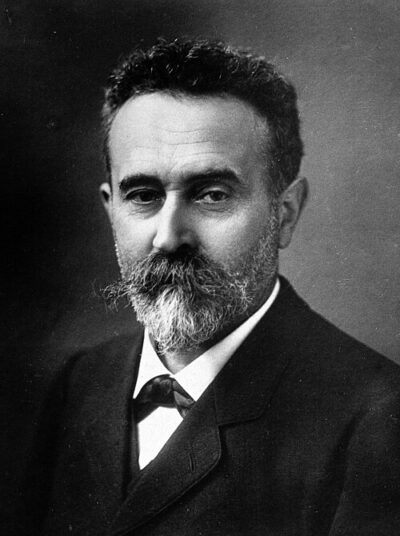
Alphonse Bertillon
Alphonse Bertillon was a French forensic scientist. Born April 22, 1853, in former 7th arrondissement of Paris. Died February 13, 1914, in 16th arrondissement of Paris. Known for Identification anthropométrique and History of anthropemetry#Bertillon, Galton and criminology. Awards include Knight of the Legion of Honour.
Facts
20 facts · 2 confirmed by two sources · 5 cited · 12 from one source · 1 where the sources disagree
What’s different
- Buried in: we show Père Lachaise Cemetery (Sources disagree). Wikidata also lists Alphonse Bertillon's tomb
Where this comes from
Papalocal keeps its own record. It started from these sources; what each one said is kept here as it was copied, so a change on their side never changes this page by itself. Tap one to read its version.
What Wikidata says · copied November 16, 2026 · revision 2563491335
- Described as
- French forensic scientist (1853–1914)
- Born
- April 22, 1853 · 2 references
- Died
- February 13, 1914 · 9 references
- Born in
- former 7th arrondissement of Paris · 3 references
- Died in
- 16th arrondissement of Paris · 1 reference
- Buried in
- Père Lachaise Cemetery · 1 reference; Alphonse Bertillon's tomb
- Citizen of
- France · 2 references
- Occupation
- police officer; anthropologist · 1 reference; criminologist · 1 reference; photographer · 3 references; criminal investigator
- Worked for
- Prefecture of Police of Paris (1879–)
- Known for
- Identification anthropométrique; History of anthropemetry#Bertillon, Galton and criminology
- Awards
- Knight of the Legion of Honour (1893–) · 1 reference
- Field
- History of anthropemetry#Bertillon, Galton and criminology
- Father
- Louis-Adolphe Bertillon · 1 reference
- Mother
- Zoé Guillard
- Siblings
- Jacques Bertillon; Georges Bertillon
- Wikipedias with a page
- 31
Wikidata item Q568386 (wikidata.org/wiki/Q568386), public domain (CC0). Copied November 16, 2026.
What Wikipedia says · copied November 16, 2026 · revision 1378282145
Alphonse Bertillon (French: [bɛʁtijɔ̃]; 22 April 1853 – 13 February 1914) was a French police officer and biometrics researcher who applied the anthropological technique of anthropometry to law enforcement, creating an identification system based on physical measurements.
Anthropometry was the first scientific system used by police to identify criminals. Before that time, criminals could only be identified by name or photograph. The method was eventually supplanted by fingerprinting.
He is also the inventor of the mug shot. Photographing of criminals began in the 1840s only a few years after the invention of photography, but it was not until 1888 that Bertillon standardised the process, notably with his file on anarchists.
His flawed evidence was used to wrongly convict Alfred Dreyfus in the infamous Dreyfus affair.
- Born, in its opening lines
- April 22, 1853
- Died, in its opening lines
- February 13, 1914
From the Wikipedia article “Alphonse Bertillon” (en.wikipedia.org/wiki/Alphonse_Bertillon), by its contributors, under CC BY-SA 4.0 (creativecommons.org/licenses/by-sa/4.0/). Copied November 16, 2026; not changed.
Confirmed Two sources agree. Cited One source, and it names where it got it. One source One source, without a reference of its own. Sources disagree The sources disagree. We show the best-supported value and keep theirs below.
