
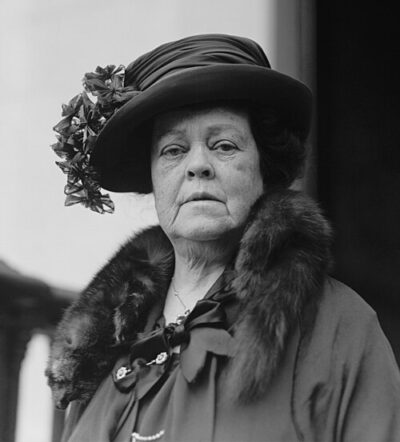
Alva Belmont
Alva Belmont was an American suffragette and socialite. Born January 17, 1853, in Mobile. Died January 26, 1933, in Paris. Positions held include chairperson (1921–1933). Known for Marble House.
Facts
28 facts · 2 confirmed by two sources · 15 cited · 10 from one source · 1 where the sources disagree
What’s different
- Died in: we show Paris (Sources disagree). Wikidata also lists Augerville-la-Rivière
Where this comes from
Papalocal keeps its own record. It started from these sources; what each one said is kept here as it was copied, so a change on their side never changes this page by itself. Tap one to read its version.
What Wikidata says · copied November 16, 2026 · revision 2558021897
- Described as
- American suffragette and socialite (1853–1933)
- Other names
- Alva Vanderbilt Belmont, Mrs O.H.P. Belmont, Alva Smith, Alva Smith Vanderbilt, Alva Vanderbilt, Alva Erskine Smith Vanderbilt Belmont, Alva Erskine Belmont
- Born
- January 17, 1853 · 5 references
- Died
- January 26, 1933 · 5 references
- Born in
- Mobile
- Died in
- Augerville-la-Rivière; Paris · 1 reference
- Buried in
- Woodlawn Cemetery · 1 reference
- Name at birth
- Alva Erskine Smith · 1 reference
- Citizen of
- United States · 1 reference
- Occupation
- socialite; suffragist · 1 reference; patron of the arts · 1 reference; political activist · 1 reference
- Positions held
- chairperson (1921–1933)
- Member of
- National American Woman Suffrage Association; National Woman's Party · 1 reference
- Known for
- Marble House
- Field
- art patronage · 1 reference; feminist movement · 1 reference; women's rights · 1 reference; active suffrage · 1 reference; activism · 1 reference
- Spouse
- William Kissam Vanderbilt I (1875–1895) · 1 reference; Oliver Belmont (1896–) · 2 references
- Children
- William Kissam Vanderbilt II; Harold Stirling Vanderbilt · 1 reference; Consuelo Vanderbilt
- Father
- Murray Forbes Smith · 1 reference
- Mother
- Phoebe Desha · 1 reference
- Siblings
- Julia Florence Smith
- Wikipedias with a page
- 21
Wikidata item Q448169 (wikidata.org/wiki/Q448169), public domain (CC0). Copied November 16, 2026.
What Wikipedia says · copied November 16, 2026 · revision 1375704653
Alva Erskine Belmont (née Smith; January 17, 1853 – January 26, 1933), known as Alva Vanderbilt from 1875 to 1896, was an American multi-millionaire socialite and women's suffrage activist. She was noted for her energy, intelligence, strong opinions, and willingness to challenge convention.
In 1909, she founded the Political Equality Association to get votes for suffrage-supporting New York State politicians, wrote articles for newspapers, and joined the National American Woman Suffrage Association (NAWSA). She later formed her own Political Equality Association to seek broad support for suffrage in neighborhoods throughout New York City, and, as its president, led its division of New York City's 1912 Women's Votes Parade. In 1916, she was one of the founders of the National Woman's Party (NWP) and organized the first picketing ever to take place before the White House, in January 1917. She was elected president of the NWP, an office she held until her death.
She was married twice, to socially prominent New York City millionaires William Kissam Vanderbilt, with whom she had three children, and Oliver Hazard Perry Belmont. Alva was known for her many building projects, including the Petit Chateau in New York; the Marble House in Newport, Rhode Island; the Belmont House in New York; Brookholt in Long Island; and Beacon Towers in Sands Point, New York.
On "Equal Pay Day," April 12, 2016, Belmont was honored when President Barack Obama established the Belmont-Paul Women's Equality National Monument in Washington, D.C., named for Alva Belmont and Alice Paul.
- Born, in its opening lines
- January 17, 1853
- Died, in its opening lines
- January 26, 1933
From the Wikipedia article “Alva Belmont” (en.wikipedia.org/wiki/Alva_Belmont), by its contributors, under CC BY-SA 4.0 (creativecommons.org/licenses/by-sa/4.0/). Copied November 16, 2026; not changed.
Confirmed Two sources agree. Cited One source, and it names where it got it. One source One source, without a reference of its own. Sources disagree The sources disagree. We show the best-supported value and keep theirs below.
