
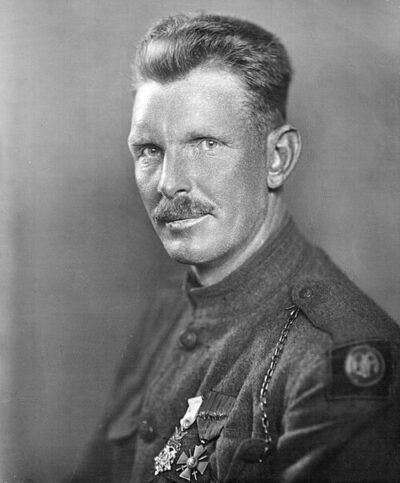
Alvin York
Alvin York was an United States Army Medal of Honor recipient. Born December 13, 1887, in Fentress County. Died September 2, 1964, in Nashville. Awards include Medal of Honor, Knight of the Legion of Honour and Médaille militaire.
Facts
28 facts · 2 confirmed by two sources · 4 cited · 22 from one source
Where this comes from
Papalocal keeps its own record. It started from these sources; what each one said is kept here as it was copied, so a change on their side never changes this page by itself. Tap one to read its version.
What Wikidata says · copied November 15, 2026 · revision 2555392010
- Described as
- United States Army Medal of Honor recipient (1887-1964)
- Other names
- Alvin C. York, Sergeant York, Alvin Cullum York
- Born
- December 13, 1887 · 2 references
- Died
- September 2, 1964 · 2 references
- Born in
- Fentress County
- Died in
- Nashville · 1 reference
- Buried in
- Pall Mall
- Cause of death
- cerebral hemorrhage
- Name at birth
- Alvin Cullum York
- Citizen of
- United States
- Occupation
- military personnel; diarist · 1 reference; national hero · 1 reference; soldier · 1 reference
- Political party
- Tennessee Democratic Party
- Member of
- American Legion · 1 reference; Veterans of Foreign Wars
- Awards
- Medal of Honor; Knight of the Legion of Honour; Médaille militaire; Croix de guerre 1914–1918; War Merit Cross (Italy); Order of Prince Danilo I; World War I Victory Medal (United States) · 1 reference; American Campaign Medal; World War II Victory Medal
- Military branch
- United States Army (1917–1919)
- Military rank
- Sergeant (1918–1919); soldier
- Website
- https://sgtyork.org/
- Wikipedias with a page
- 31
Wikidata item Q449068 (wikidata.org/wiki/Q449068), public domain (CC0). Copied November 15, 2026.
What Wikipedia says · copied November 15, 2026 · revision 1379812074
Alvin Cullum York (December 13, 1887 – September 2, 1964), also known by his rank as Sergeant York, was one of the most decorated United States Army soldiers of World War I. He received the Medal of Honor for leading an attack on a German machine gun nest, gathering 35 machine guns, killing at least 25 enemy soldiers, and capturing 132 prisoners. York's Medal of Honor action occurred during the United States-led portion of the Meuse–Argonne offensive in France, which sought to breach the Hindenburg line and force the Germans to surrender. He earned decorations from several Allied countries during the war, including France, Italy, and Montenegro.
York was born in rural Tennessee, in what is now the community of Pall Mall in Fentress County. His parents farmed, and his father also worked as a blacksmith. The 11 York children had minimal schooling because they helped provide for the family, including hunting, fishing, and working as laborers. After the death of his father, York assisted in caring for his younger siblings and found work as a blacksmith. Despite regularly going to church, York also drank heavily and was prone to fistfights. After a 1914 conversion experience, he vowed to improve and became even more devoted to the Church of Christ in Christian Union. York was drafted during World War I; he initially claimed conscientious objector status on the grounds that his religious denomination forbade violence. Persuaded that his religion was not incompatible with military service, York joined the 82nd Division as an infantry private and went to France in 1918.
In October 1918, Private First Class (Acting Corporal) York was one of a group of 17 soldiers assigned to infiltrate German lines and silence a machine gun position. After the American patrol had captured a large group of enemy soldiers, German small arms fire killed six Americans and wounded three. Several of the Americans returned fire, while others guarded the prisoners. York and the other Americans attacked the machine gun position, killing several German soldiers. The German officer responsible for the machine gun position had emptied his pistol while firing at York, but failed to hit him. This officer then offered to surrender and York accepted. York and his men marched back to their unit's command post with more than 130 prisoners. York was later promoted to sergeant and was awarded the Distinguished Service Cross. An investigation resulted in the upgrading of the award to the Medal of Honor. York's feat made him a national hero and international celebrity among Allied nations.
After Armistice Day, a group of Tennessee businessmen purchased a farm for York, his new wife, and their growing family. He later formed a charitable foundation to improve educational opportunities for children in rural Tennessee. In the 1930s and 1940s, York worked as a project superintendent for the Civilian Conservation Corps and managed construction of the Byrd Lake Reservoir at Cumberland Mountain State Park, after which he served for several years as park superintendent. A 1941 film about his World War I exploits, Sergeant York, was that year's highest-grossing film; Gary Cooper won the Academy Award for Best Actor for his portrayal of York, and the film was credited with enhancing American morale as the U.S. mobilized for action in World War II. In his later years, York was confined to bed by health problems. He died in Nashville, Tennessee, in 1964, and was buried at Wolf River Cemetery in his hometown of Pall Mall, Tennessee.
- Born, in its opening lines
- December 13, 1887
- Died, in its opening lines
- September 2, 1964
From the Wikipedia article “Alvin York” (en.wikipedia.org/wiki/Alvin_York), by its contributors, under CC BY-SA 4.0 (creativecommons.org/licenses/by-sa/4.0/). Copied November 15, 2026; not changed.
Confirmed Two sources agree. Cited One source, and it names where it got it. One source One source, without a reference of its own. Sources disagree The sources disagree. We show the best-supported value and keep theirs below.
