
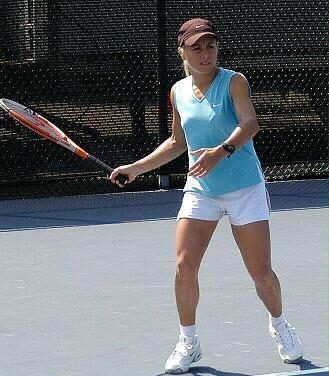
Amanda Coetzer is a South African tennis player. Born October 22, 1971, in Hoopstad.
Facts
9 facts · 1 confirmed by two sources · 3 cited · 5 from one source
Where this comes from
Papalocal keeps its own record. It started from these sources; what each one said is kept here as it was copied, so a change on their side never changes this page by itself. Tap one to read its version.
What Wikidata says · copied November 16, 2026 · revision 2521936645
- Described as
- South African tennis player
- Born
- October 22, 1971 · 1 reference
- Born in
- Hoopstad · 1 reference
- Citizen of
- South Africa
- Occupation
- tennis player (1988–2004)
- Sport
- tennis · 1 reference
- Spouse
- Arnon Milchan · 1 reference
- Lived in
- Hoopstad
- Nickname
- The Little Assassin · 1 reference
- Height
- 1.58 m (5 ft 2 in)
- Wikipedias with a page
- 31
Wikidata item Q233339 (wikidata.org/wiki/Q233339), public domain (CC0). Copied November 16, 2026.
What Wikipedia says · copied November 16, 2026 · revision 1384474489
Amanda Coetzer (born 22 October 1971) is a South African former professional tennis player. She was ranked as high as world No. 3 by the Women's Tennis Association, achieved in November 1997. Coetzer won nine WTA Tour titles in singles and nine in doubles, and reached three major singles semifinals (at the 1996 and 1997 Australian Opens and the 1997 French Open) and one major doubles final (at the 1993 US Open). Coetzer earned a reputation for regularly beating players who were ranked higher than her. By virtue of scoring so many upset wins in spite of her 5'2" (1.58m) stature, she gained the nickname: "The Little Assassin".
- Born, in its opening lines
- October 22, 1971
From the Wikipedia article “Amanda Coetzer” (en.wikipedia.org/wiki/Amanda_Coetzer), by its contributors, under CC BY-SA 4.0 (creativecommons.org/licenses/by-sa/4.0/). Copied November 16, 2026; not changed.
Confirmed Two sources agree. Cited One source, and it names where it got it. One source One source, without a reference of its own. Sources disagree The sources disagree. We show the best-supported value and keep theirs below.
