
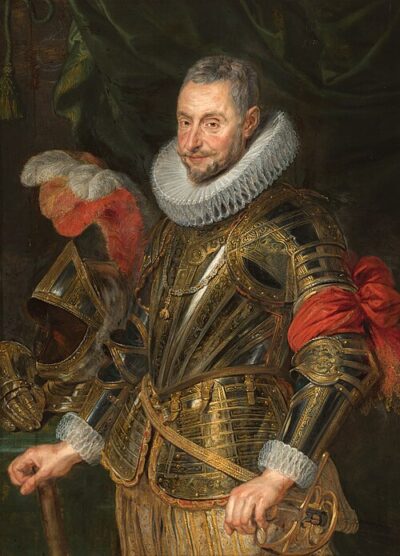
Ambrogio Spinola, 1st Marquis of the Balbases
Ambrogio Spinola, 1st Marquis of the Balbases was an Italian general. Born 1569, in Genoa. Died September 25, 1630, in Castelnuovo Scrivia. Positions held include Governor of Milan (1629–1630), Marquis of the Balbases and Duke of Sesto. Awards include Knight of the Order of the Golden Fleece and Knight of the Order of Santiago.
Facts
25 facts · 2 confirmed by two sources · 11 cited · 12 from one source
Where this comes from
Papalocal keeps its own record. It started from these sources; what each one said is kept here as it was copied, so a change on their side never changes this page by itself. Tap one to read its version.
What Wikidata says · copied November 16, 2026 · revision 2568742258
- Described as
- Italian general (1569–1630)
- Other names
- Ambrosio, Marquis of Spinola, Ambrogio Spinola, 1.Marquess of Los Balbases, Ambrogio Spinola Doria, Ambrosio Spinola, Ambrogio Spinola, A. Spinola, Spinola, A. Spínola, Spínola, Ambroise Spinola, Ambrogio Spínola Doria, Ambrosio Spínola
- Born
- 1569 · 1 reference
- Died
- September 25, 1630 · 3 references
- Born in
- Genoa
- Died in
- Castelnuovo Scrivia · 1 reference
- Buried in
- Castelnuovo Scrivia · 1 reference
- Citizen of
- Spain
- Occupation
- military officer; soldier · 1 reference; military leader · 1 reference; Generalfeldmarschall · 1 reference
- Positions held
- Governor of Milan (1629–1630); Marquis of the Balbases; Duke of Sesto
- Awards
- Knight of the Order of the Golden Fleece; Knight of the Order of Santiago
- Spouse
- Giovanetta Bacciadonne · 1 reference; Marie d'Aumale
- Children
- Filippo Spinola, 2nd Marquis of the Balbases · 1 reference; Agustín de Spínola Basadone · 1 reference; Polissena Spinola · 1 reference
- Father
- Filippo Spinola, Marchese di Venafro · 1 reference
- Mother
- Polissena Grimaldi, Baronessa di Casalnuovo · 1 reference
- Siblings
- Federico Spínola · 1 reference
- Military branch
- infantry
- Military rank
- general · 2 references
- Wikipedias with a page
- 33
Wikidata item Q359936 (wikidata.org/wiki/Q359936), public domain (CC0). Copied November 16, 2026.
What Wikipedia says · copied November 16, 2026 · revision 1385279444
Ambrogio Spinola, 1st Marquess of Los Balbases and 1st Duke of Sesto (1569 – 25 September 1630) was an Italian nobleman and military leader from the Republic of Genoa in the service of the Spanish Empire. He distinguished himself in several key engagements during the Eighty Years' War and the Thirty Years' War, and is regarded as one of the greatest military commanders of his time and in the history of the Spanish army.
Born into a prominent family in the Republic of Genoa, Spinola entered Spanish service in 1602, raised 9,000 men at his own expense and conducted a successful siege at Ostend. His early victories led to his appointment as commander-in-chief in Flanders by King Philip II. Demonstrating his mastery of siege warfare, he led a one-year campaign that resulted in the capture of a string of cities along the Rhine from Maurice of Nassau, but also brought about his own financial ruin.
Early in the Thirty Years' War, Spinola conducted the Palatinate campaign. Following the end of the Twelve Years' Truce in the Low Countries, Spinola achieved the most famous victory of his career by capturing Breda in 1624. Political intrigues, in particular his rivalry with the royal favourite Olivares, hindered his military efforts, and he left Flanders in 1628. Spinola died in 1630 while conducting the siege of Casale during the War of the Mantuan Succession.
- Born, in its opening lines
- 1569
- Died, in its opening lines
- September 25, 1630
From the Wikipedia article “Ambrogio Spinola” (en.wikipedia.org/wiki/Ambrogio_Spinola), by its contributors, under CC BY-SA 4.0 (creativecommons.org/licenses/by-sa/4.0/). Copied November 16, 2026; not changed.
Confirmed Two sources agree. Cited One source, and it names where it got it. One source One source, without a reference of its own. Sources disagree The sources disagree. We show the best-supported value and keep theirs below.
