
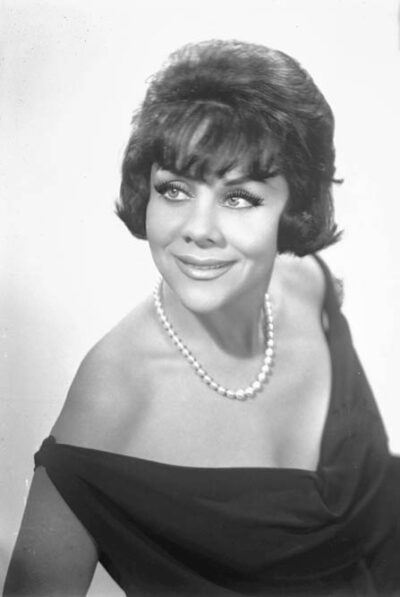
Amelia Bence
Amelia Bence was an Argentine film actress. Born November 13, 1914, in Buenos Aires. Died February 8, 2016, in Buenos Aires. Awards include Silver Condor Award.
Facts
12 facts · 2 confirmed by two sources · 3 cited · 7 from one source
Where this comes from
Papalocal keeps its own record. It started from these sources; what each one said is kept here as it was copied, so a change on their side never changes this page by itself. Tap one to read its version.
What Wikidata says · copied November 18, 2026 · revision 2567179546
- Described as
- Argentine film actress (1914–2016)
- Other names
- María Amelia Botwinik, Maria Amelia Botwinik
- Born
- November 13, 1914 · 2 references
- Died
- February 8, 2016 · 1 reference
- Born in
- Buenos Aires · 1 reference
- Died in
- Buenos Aires · 1 reference
- Buried in
- La Chacarita Cemetery
- Name at birth
- María Batvinik
- Citizen of
- Argentina
- Occupation
- film actor; actor · 1 reference
- Awards
- Silver Condor Award
- Spouse
- Alberto Closas
- Siblings
- Esther Bence
- Wikipedias with a page
- 22
Wikidata item Q4083859 (wikidata.org/wiki/Q4083859), public domain (CC0). Copied November 18, 2026.
What Wikipedia says · copied November 18, 2026 · revision 1377102930
Amelia Bence (born María Amelia Batvinik; 13 November 1914 – 8 February 2016) was an Argentine film actress and one of the divas of the Golden Age of Argentine cinema during the 1930s and 1950s.
Born to Belarusian Jewish immigrants, Bence began her career at a young age, studying with Alfonsina Storni at the Lavardén Children's Theater and with Mecha Quintana at the Conservatorio Nacional de Música y Declamación (National Conservatory of Music and Speech). She made her film debut in 1933, in only the second sound film of Argentina, Dancing, by Luis Moglia Barth. Bence's acting in La guerra gaucha (1942), one of the most important films in the history of Argentine cinema, gave her recognition and earned her leading role offers. She starred in films such as Los ojos más lindos del mundo (1943), Todo un hombre, Camino del infierno (1946), A sangre fría (1947), La otra y yo (1949) and Danza del fuego (1949), garnering the Best Actress award from the Argentine Academy of Cinematography Arts and Sciences for Todo un hombre, A sangre fría and Danza del fuego. Bence also won the Silver Condor Award for Best Actress for Lauracha (1946), and her work was acknowledged with awards in Spain, Cuba, and the United States throughout the 1940s and 1950s.
Bence married Spanish actor Alberto Closas in 1950, and after their divorce in 1955 she was in a relationship with Osvaldo Cattone in the 1960s. From 1952 to 1954, Bence was contracted by Reforma Films to film two movies in Mexico and earned high praise for her starring role in Alfonsina (1957), which was selected as the Argentine entry for the Berlin International Film Festival and won her an award from the Argentina Film Academy. She developed an extensive theater career in the 1960s, starring in works like "La dama del trébol", "Así es la vida", "Maribel y la extraña familia" and "El proceso de Mary Duggan".
From 1973 to 1976, she completed a long tour of Latin America and featured in "La valija" ("The Suitcase") at the Gramercy Arts Theater in New York City, which earned her an Association of Latin Entertainment Critics (ACE) Award for Best Foreign Actress. Bence's characterizations in "Doña Rosita, la soltera" (1975) and "La loba" (1982) in the United States and Peru were very successful.
During the last stage of her career, she acted in several television productions, including series such as Romina, Bianca and Las 24 horas.
In 1989, she received the Silver Condor for Lifetime Achievement Award, and later won awards in the same category at the Podesta Awards in 1992 and by the National Endowment for the Arts in 1997.
Between 1996 and 2010, she appeared in several theaters with her show "Alfonsina", which combined music and poetry. After a career spanning eight decades in entertainment, she retired in 2010.
- Born, in its opening lines
- November 13, 1914
- Died, in its opening lines
- February 8, 2016
From the Wikipedia article “Amelia Bence” (en.wikipedia.org/wiki/Amelia_Bence), by its contributors, under CC BY-SA 4.0 (creativecommons.org/licenses/by-sa/4.0/). Copied November 18, 2026; not changed.
Confirmed Two sources agree. Cited One source, and it names where it got it. One source One source, without a reference of its own. Sources disagree The sources disagree. We show the best-supported value and keep theirs below.
