
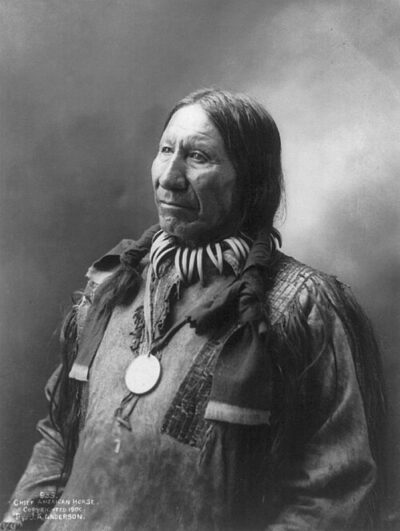
American Horse was a Lakota chief. Born 1840, in Black Hills. Died December 16, 1908, in Pine Ridge.
Facts
7 facts · 2 confirmed by two sources · 1 cited · 4 from one source
Where this comes from
Papalocal keeps its own record. It started from these sources; what each one said is kept here as it was copied, so a change on their side never changes this page by itself. Tap one to read its version.
What Wikidata says · copied November 18, 2026 · revision 2508050507
- Described as
- Lakota chief (1840-1908)
- Other names
- American Horse the Younger, Wašíčuŋ Tȟašúŋke
- Born
- 1840 · 3 references
- Died
- December 16, 1908 · 3 references
- Born in
- Black Hills · 1 reference
- Died in
- Pine Ridge
- Citizen of
- United States
- Occupation
- traditional leader or chief
- Field
- Sioux
- Wikipedias with a page
- 17
Wikidata item Q465027 (wikidata.org/wiki/Q465027), public domain (CC0). Copied November 18, 2026.
What Wikipedia says · copied November 18, 2026 · revision 1379607711
American Horse (Lakota: Wašíčuŋ Tȟašúŋke; also known as American Horse the Younger; c. 1840 – December 16, 1908) was an Oglala Lakota chief, statesman, educator and historian. American Horse is notable in American history as a U.S. Army Indian Scout and a progressive Oglala Lakota leader who promoted friendly associations with whites and education for his people. American Horse opposed Crazy Horse during the Great Sioux War of 1876–1877 and the Ghost Dance Movement of 1890, and was a Lakota delegate to Washington. American Horse was one of the first Wild Westers with Buffalo Bill's Wild West and a supporter of the Carlisle Indian Industrial School. His record as a councilor of his people and his policy in the new situation that confronted them was consistent, and he was known for his eloquence.
- Born, in its opening lines
- c. 1840
- Died, in its opening lines
- December 16, 1908
From the Wikipedia article “American Horse” (en.wikipedia.org/wiki/American_Horse), by its contributors, under CC BY-SA 4.0 (creativecommons.org/licenses/by-sa/4.0/). Copied November 18, 2026; not changed.
Confirmed Two sources agree. Cited One source, and it names where it got it. One source One source, without a reference of its own. Sources disagree The sources disagree. We show the best-supported value and keep theirs below.
