
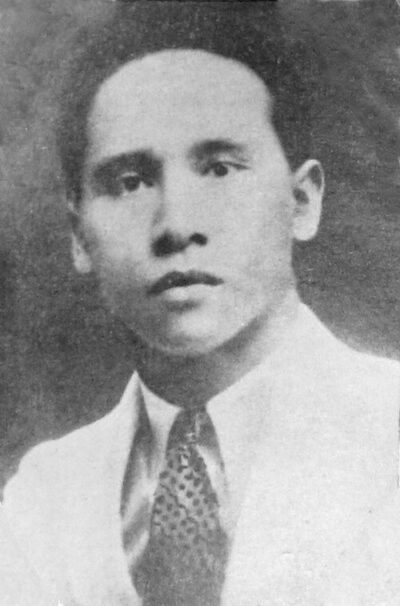
Amir Hamzah
Amir Hamzah was an Indonesian poet. Born February 28, 1911, in Langkat. Died March 20, 1946. Known for Buah Rindu and Nyanyi Sunyi. Awards include National Hero of Indonesia.
Facts
14 facts · 2 confirmed by two sources · 4 cited · 8 from one source
Where this comes from
Papalocal keeps its own record. It started from these sources; what each one said is kept here as it was copied, so a change on their side never changes this page by itself. Tap one to read its version.
What Wikidata says · copied November 16, 2026 · revision 2563209853
- Described as
- Indonesian poet (1911-1946)
- Other names
- Tengku Amir Hamzah
- Born
- February 28, 1911 · 2 references
- Died
- March 20, 1946 · 1 reference
- Born in
- Langkat
- Buried in
- Azizi Mosque · 1 reference
- Citizen of
- Indonesia
- Occupation
- linguist; poet; writer · 2 references
- Known for
- Buah Rindu; Nyanyi Sunyi
- Awards
- National Hero of Indonesia
- Field
- literature · 1 reference; creative and professional writing · 1 reference; poetry · 1 reference
- Wikipedias with a page
- 30
Wikidata item Q3981632 (wikidata.org/wiki/Q3981632), public domain (CC0). Copied November 16, 2026.
What Wikipedia says · copied November 16, 2026 · revision 1371333090
Tengku Amir Hamzah (February 1911 – 20 March 1946) was an Indonesian poet and National Hero of Indonesia. Born into a Malay aristocratic family in the Sultanate of Langkat in North Sumatra, he was educated in both Sumatra and Java. While attending senior high school in Surakarta around 1930, Amir became involved with the nationalist movement and fell in love with a Javanese schoolmate, Ilik Sundari. Even after Amir continued his studies in legal school in Batavia (now Jakarta) the two remained close, only separating in 1937 when Amir was recalled to Sumatra to marry the sultan's daughter and take on responsibilities of the court. Though unhappy with his marriage, he fulfilled his courtly duties. After Indonesia proclaimed its independence in 1945, he served as the government's representative in Langkat. The following year he was killed in a social revolution led by the PESINDO (Pemuda Sosialis Indonesia), and buried in a mass grave.
Amir began writing poetry while still a teenager: though his works are undated, the earliest are thought to have been written when he first travelled to Java. Drawing influences from his own Malay culture and Islam, as well as from Christianity and Eastern literature, Amir wrote 50 poems, 18 pieces of lyrical prose, and numerous other works, including several translations. In 1932 he co-founded the literary magazine Poedjangga Baroe. After his return to Sumatra, he stopped writing. Most of his poems were published in two collections, Nyanyi Sunyi (1937) and Buah Rindu (1941), first in Poedjangga Baroe then as stand-alone books.
Poems by Amir deal with the themes of love and religion and his poetry often reflects a deep inner conflict. His diction, using both Malay and Javanese words and expanding on traditional structures, was influenced by the need for rhythm and metre, as well as symbolism related to particular terms. His earlier works deal with a sense of longing and both erotic and idealised love, whereas his later works have a deeper religious meaning. Of his two collections, Nyanyi Sunyi is considered the most developed. Amir has been called the "King of the Poedjangga Baroe-era Poets" and the only international-class Indonesian poet from before the Indonesian National Revolution.
- Born, in its opening lines
- February 1911
- Died, in its opening lines
- March 20, 1946
From the Wikipedia article “Amir Hamzah” (en.wikipedia.org/wiki/Amir_Hamzah), by its contributors, under CC BY-SA 4.0 (creativecommons.org/licenses/by-sa/4.0/). Copied November 16, 2026; not changed.
Confirmed Two sources agree. Cited One source, and it names where it got it. One source One source, without a reference of its own. Sources disagree The sources disagree. We show the best-supported value and keep theirs below.
