
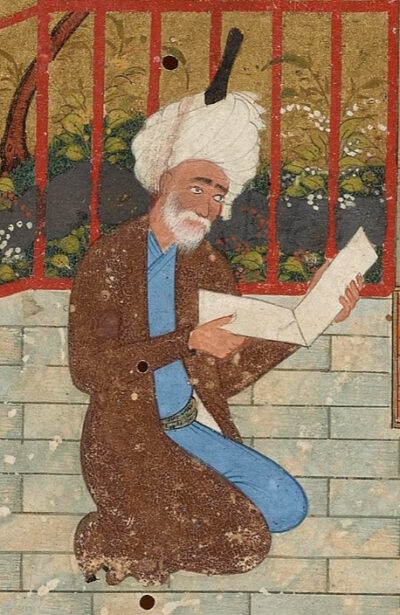
Amir Khusrau
Amir Khusrau was an Indian poet, writer, singer and scholar. Born 1253, in Patiyali. Died September 27, 1325, in Delhi.
Facts
14 facts · 2 confirmed by two sources · 6 cited · 6 from one source
Where this comes from
Papalocal keeps its own record. It started from these sources; what each one said is kept here as it was copied, so a change on their side never changes this page by itself. Tap one to read its version.
What Wikidata says · copied November 16, 2026 · revision 2565600303
- Described as
- Indian poet, writer, singer and scholar (1253–1325)
- Other names
- Amir Khusrow, Amir Khusrau Dihlavi, Ab'ul Hasan Yamīn ud-Dīn Khusro, Ab'ul Hasan Yamīn ud-Dīn Khusrau, Amir Khushrow Dehlavi, Amīr Khusraw Dihlavī, Amir Khosrow
- Born
- 1253 · 2 references
- Died
- September 27, 1325
- Born in
- Patiyali · 1 reference
- Died in
- Delhi · 2 references
- Buried in
- Tomb of Amir Khusro
- Citizen of
- India · 1 reference
- Occupation
- poet · 2 references; philosopher; writer · 2 references; musician · 2 references
- Genre
- ghazal
- Father
- Amir Saif ud-Din Mahmud
- Mother
- Bibi Daulatnaz
- Religion
- Islam
- Wikipedias with a page
- 79
Wikidata item Q207817 (wikidata.org/wiki/Q207817), public domain (CC0). Copied November 16, 2026.
What Wikipedia says · copied November 16, 2026 · revision 1385382786
Abu'l Hasan Yamīn ud-Dīn Khusrau (1253 – October 1325), better known as Amīr Khusrau, sometimes spelled as Amir Khusrow or Amir Khusro, was an Indo-Persian Sufi singer, musician, court poet and scholar, who lived during the period of the Delhi Sultanate.
He is an iconic figure in the cultural history of the Indian subcontinent. He was a mystic and a spiritual disciple of Nizamuddin Auliya of Delhi, India. He wrote poetry primarily in Persian, but also in Hindavi and Punjabi. A vocabulary in verse, the Ḳhāliq Bārī, containing Arabic, Persian and Hindavi terms is often attributed to him. Khusrau is sometimes referred to as the "voice of India" or "Parrot of India" (Tuti-e-Hind).
Khusrau is regarded as the "father of qawwali" (a devotional form of singing of the Sufis in the Indian subcontinent), and introduced the ghazal style of song into India, both of which still exist widely in India and Pakistan. Khusrau was an expert in many styles of Persian poetry which were developed in medieval Persia, from Khāqānī's qasidas to Nizami's khamsa. He used 11 metrical schemes with 35 distinct divisions. He wrote in many verse forms including ghazal, masnavi, qata, rubai, do-baiti and tarkib-band. His contribution to the development of the ghazal was significant.
- Born, in its opening lines
- 1253
- Died, in its opening lines
- October 1325
From the Wikipedia article “Amir Khusrau” (en.wikipedia.org/wiki/Amir_Khusrau), by its contributors, under CC BY-SA 4.0 (creativecommons.org/licenses/by-sa/4.0/). Copied November 16, 2026; not changed.
Confirmed Two sources agree. Cited One source, and it names where it got it. One source One source, without a reference of its own. Sources disagree The sources disagree. We show the best-supported value and keep theirs below.
