
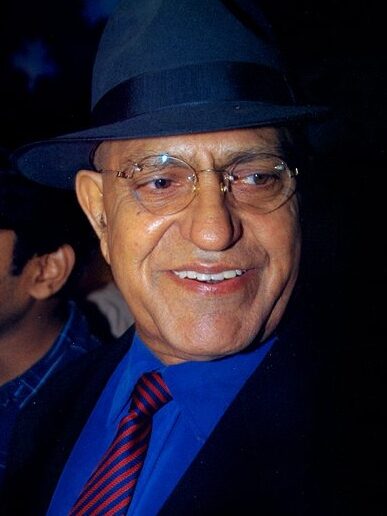
Amrish Puri
Amrish Puri was an Indian actor. Born June 22, 1932, in Jalandhar. Died January 12, 2005, in Mumbai. Known for Tridev and Baadshah. Awards include Sangeet Natak Akademi Award, Filmfare Award for Best Supporting Actor and Zee Cine Awards.
Facts
20 facts · 2 confirmed by two sources · 1 cited · 17 from one source
Where this comes from
Papalocal keeps its own record. It started from these sources; what each one said is kept here as it was copied, so a change on their side never changes this page by itself. Tap one to read its version.
What Wikidata says · copied November 16, 2026 · revision 2567089328
- Described as
- Indian actor (1932–2005)
- Other names
- Amrishlal Puri, Amrish Lal Puri
- Born
- June 22, 1932 · 4 references
- Died
- January 12, 2005 · 3 references
- Born in
- Jalandhar
- Died in
- Mumbai
- Cause of death
- cerebral hemorrhage
- Citizen of
- India (1947–); British Raj (–1947); Dominion of India
- Occupation
- stage actor; film actor; actor · 2 references
- Known for
- Tridev; Baadshah
- Awards
- Sangeet Natak Akademi Award (1979); Filmfare Award for Best Supporting Actor (1986); Zee Cine Awards
- Siblings
- Madan Puri; Chaman Puri
- Religion
- Hinduism
- Height
- 1.75 m (5 ft 9 in)
- Wikipedias with a page
- 55
Wikidata item Q333443 (wikidata.org/wiki/Q333443), public domain (CC0). Copied November 16, 2026.
What Wikipedia says · copied November 16, 2026 · revision 1383117641
Amrish Puri (22 June 1932 – 12 January 2005) was an Indian actor, who predominantly worked in Hindi cinema. He was one of the most notable and important figures in Indian cinema and theatre. Puri was known for his acting versatility. His dominating screen presence and distinctive deep voice made him stand out amongst other actors of his generation. Puri acted in more than 450 films, and established himself as one of the greatest actors in Indian cinema. He holds most Filmfare Award for Best Villain nominations.
While he primarily worked in Hindi-language films, he had also appeared in Telugu, Kannada, Tamil, Malayalam and Marathi language films.
Puri gained widespread recognition for his antagonist roles since mid-1980s to 1990s. His most notable films include Vidhaata (1982), Shakti (1982), Hero (1983), Meri Jung (1985), Nagina (1986), Mr. India (1987), Shahenshah (1988), Ram Lakhan (1989), Tridev (1990), Ghayal (1990), Saudagar (1991), Thalapathi (1991), Tahalka (1992), Damini (1993), Karan Arjun (1995), Kaalapani (1996), Jeet (1996), Koyla (1997), Gadar: Ek Prem Katha (2001), and Nayak: The Real Hero (2001). His notable Telugu films include Kondaveeti Donga (1988), Jagadeka Veerudu Athiloka Sundari (1990), and Aditya 369 (1991). Puri's performance as the main antagonist "Mogambo" in Shekhar Kapur's Mr. India (1987) is considered as one of the greatest villain performances of all time in Indian cinema. It is reported that he received a salary of ₹1 crore (US$771,890), making him the highest-paid villain actors of the time. His comic role in Chachi 420, opposite Kamal Haasan, was also well received by critics.
Puri was active in art cinema, including films by Shyam Benegal and Govind Nihalani. He also appeared in supporting roles, of which he won Filmfare Awards for Best Supporting Actor three times. Some of his notable roles were Phool Aur Kaante (1991), Gardish (1993), Dilwale Dulhaniya Le Jayenge (1995), Ghatak (1996), Diljale (1996) Pardes (1997), Virasat (1997), China Gate (1998), Badal (2000), Mujhe Kucch Kehna Hai (2001), Mujhse Shaadi Karogi (2004) and Hulchul (2004). In international films, he was best known as Mola Ram in the Steven Spielberg and George Lucas Hollywood film Indiana Jones and the Temple of Doom (1984) and as Dada Abdulla Hajee Adab, president of the Natal Indian Congress in Richard Attenborough's Gandhi (1982).
- Born, in its opening lines
- June 22, 1932
- Died, in its opening lines
- January 12, 2005
From the Wikipedia article “Amrish Puri” (en.wikipedia.org/wiki/Amrish_Puri), by its contributors, under CC BY-SA 4.0 (creativecommons.org/licenses/by-sa/4.0/). Copied November 16, 2026; not changed.
Confirmed Two sources agree. Cited One source, and it names where it got it. One source One source, without a reference of its own. Sources disagree The sources disagree. We show the best-supported value and keep theirs below.
