
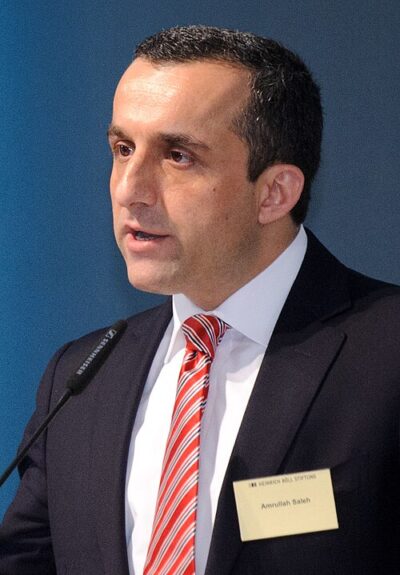
Amrullah Saleh
Amrullah Saleh is a First Vice President of Afghanistan from 2020 to 2021. Born October 15, 1972, in Panjshir Province. Positions held include Minister of the Interior of Afghanistan (2018–2019) and Vice President of Afghanistan (2020–2021).
Facts
12 facts · 1 confirmed by two sources · 1 cited · 10 from one source
Where this comes from
Papalocal keeps its own record. It started from these sources; what each one said is kept here as it was copied, so a change on their side never changes this page by itself. Tap one to read its version.
What Wikidata says · copied November 16, 2026 · revision 2569736701
- Described as
- First Vice President of Afghanistan from 2020 to 2021
- Other names
- Amrullah Salih
- Born
- October 15, 1972
- Born in
- Panjshir Province
- Citizen of
- Kingdom of Afghanistan (–1973); Republic of Afghanistan (1973–1978); Democratic Republic of Afghanistan (1978–1992); Islamic State of Afghanistan (1992–2002)
- Occupation
- politician · 1 reference
- Positions held
- Minister of the Interior of Afghanistan (2018–2019) · 1 reference; Vice President of Afghanistan (2020–2021) · 1 reference
- Political party
- Basej-e Milli
- Siblings
- Rohullah Azizi
- Religion
- Sunni Islam · 1 reference
- Wikipedias with a page
- 45
Wikidata item Q477828 (wikidata.org/wiki/Q477828), public domain (CC0). Copied November 16, 2026.
What Wikipedia says · copied November 16, 2026 · revision 1376908904
Amrullah Saleh (born 15 October 1972) is an Afghan politician who served as the first vice president of Afghanistan from February 2020 to August 2021, and acting interior minister from 2018 to 2019. He was the head of the National Directorate of Security (NDS) from 2004 to 2010.
A member of the mujahideen during the civil war against Afghanistan's communist government, Saleh later joined Ahmad Shah Massoud's Northern Alliance, an anti-Taliban coalition in the northeast of the country. In 1997, Saleh became the head of the Northern Alliance's liaison office inside the Afghan Embassy in Dushanbe, Tajikistan, handling contacts with international non-governmental organizations and intelligence agencies. As head of the NDS, Saleh directed efforts to infiltrate the Taliban and locate Osama bin Laden. Saleh resigned from the NDS in 2010 amidst worsening relations with President Hamid Karzai, founding Basej-e Milli ("National Movement"), a pro-democracy and anti-Taliban political party, shortly afterward. In March 2017, he was appointed State Minister for Security Reforms by President Ashraf Ghani, serving until his resignation in June of that year. Saleh became the acting Minister of Interior Affairs in December 2018, but resigned less than a month later to become Ghani's running mate for first vice president in the 2019 presidential election. Ghani's ticket won the election, and Saleh became first vice president on 25 February 2020.
Saleh was a powerful political figure in Afghanistan and has been the target of numerous assassination attempts. An outspoken critic of the Taliban and Pakistan, Saleh has been described as combative and as having a hard-working nature.
Following the fall of Kabul to the Taliban on 15 August 2021, Ghani fled the country and Saleh relocated to the Panjshir Valley. There, Saleh proclaimed himself the caretaker president of Afghanistan and declared his support for the National Resistance Front (NRF), an anti-Taliban resistance movement led by Ahmad Massoud. Saleh fled to Tajikistan shortly after the Taliban seized control of Panjshir on 6 September 2021. He continues to support the NRF from exile, though he has failed to receive any international support for his claim to the presidency.
- Born, in its opening lines
- October 15, 1972
From the Wikipedia article “Amrullah Saleh” (en.wikipedia.org/wiki/Amrullah_Saleh), by its contributors, under CC BY-SA 4.0 (creativecommons.org/licenses/by-sa/4.0/). Copied November 16, 2026; not changed.
Confirmed Two sources agree. Cited One source, and it names where it got it. One source One source, without a reference of its own. Sources disagree The sources disagree. We show the best-supported value and keep theirs below.
