
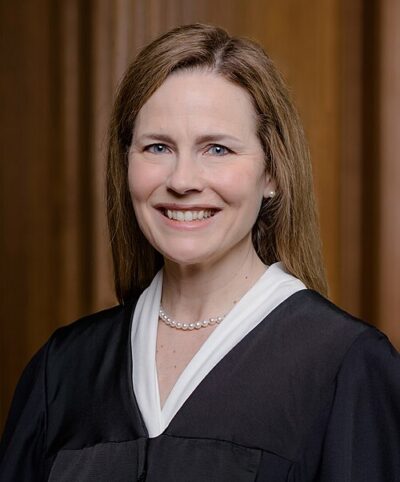
Amy Coney Barrett
Amy Coney Barrett is an American lawyer and jurist. Born January 28, 1972, in New Orleans. Positions held include Judge of the United States Court of Appeals for the Seventh Circuit (2017–2020) and Associate Justice of the Supreme Court of the United States (2020–). Educated at Notre Dame Law School and Rhodes College.
Facts
23 facts · 1 confirmed by two sources · 8 cited · 14 from one source
Where this comes from
Papalocal keeps its own record. It started from these sources; what each one said is kept here as it was copied, so a change on their side never changes this page by itself. Tap one to read its version.
What Wikidata says · copied November 13, 2026 · revision 2567337142
- Described as
- American lawyer and jurist (born 1972)
- Other names
- Amy Vivian Coney, Amy Coney, ACB, A. Barrett, Amy Vivian Coney Barrett
- Born
- January 28, 1972 · 1 reference
- Born in
- New Orleans · 1 reference
- Name at birth
- Amy Vivian Coney
- Citizen of
- United States
- Occupation
- judge; jurist · 1 reference; university teacher; lawyer · 1 reference
- Positions held
- Judge of the United States Court of Appeals for the Seventh Circuit (2017–2020); Associate Justice of the Supreme Court of the United States (2020–) · 1 reference
- Political party
- Republican Party · 1 reference
- Worked for
- Notre Dame Law School (2002–) · 1 reference; Baker Botts (2001); George Washington University Law School (2001–2002)
- Education
- Notre Dame Law School (–1997); Rhodes College (–1994); St. Mary's Dominican High School (–1990); Archbishop Rummel High School
- Member of
- Federalist Society · 1 reference; People of Praise · 1 reference; American Law Institute
- Spouse
- Jesse M. Barrett · 1 reference
- Religion
- Catholicism
- Wikipedias with a page
- 51
Wikidata item Q29863844 (wikidata.org/wiki/Q29863844), public domain (CC0). Copied November 13, 2026.
What Wikipedia says · copied November 13, 2026 · revision 1383140328
Amy Vivian Coney Barrett (née Coney; born January 28, 1972) is an American lawyer and jurist serving since 2020 as an associate justice of the Supreme Court of the United States. The fifth woman to serve on the court, she was nominated by President Donald Trump. She was a United States circuit judge of the United States Court of Appeals for the Seventh Circuit from 2017 to 2020.
Barrett graduated from Rhodes College before attending Notre Dame Law School, earning a Juris Doctor (J.D.) degree in 1997 and ranked first in her class. She then clerked for Judge Laurence Silberman and Justice Antonin Scalia. In 2002, Barrett joined the faculty at Notre Dame Law School, becoming a professor in 2010. While a circuit judge, she continued to teach civil procedure, constitutional law, and statutory interpretation.
On September 26, 2020, shortly after United States Supreme Court justice Ruth Bader Ginsburg's death, Trump nominated Barrett to succeed her. Her nomination was controversial because the 2020 presidential election was only 38 days away and Senate Republicans had refused to hold hearings for Merrick Garland during an election year in 2016. The next month, the United States Senate voted 52–48 to confirm her nomination, with all Democrats and one Republican in opposition.
Described as a protégée of Justice Antonin Scalia, Barrett supports textualism in statutory interpretation and originalism in constitutional interpretation. While generally considered to be among the Court's conservative bloc, Barrett has demonstrated a growing pattern of independence and moderation as a swing vote in some controversial cases. Barrett has said she does not think of herself as a swing vote or a conservative, but as an originalist. She published her first book, Listening to the Law, in September 2025.
- Born, in its opening lines
- January 28, 1972
From the Wikipedia article “Amy Coney Barrett” (en.wikipedia.org/wiki/Amy_Coney_Barrett), by its contributors, under CC BY-SA 4.0 (creativecommons.org/licenses/by-sa/4.0/). Copied November 13, 2026; not changed.
Confirmed Two sources agree. Cited One source, and it names where it got it. One source One source, without a reference of its own. Sources disagree The sources disagree. We show the best-supported value and keep theirs below.
