
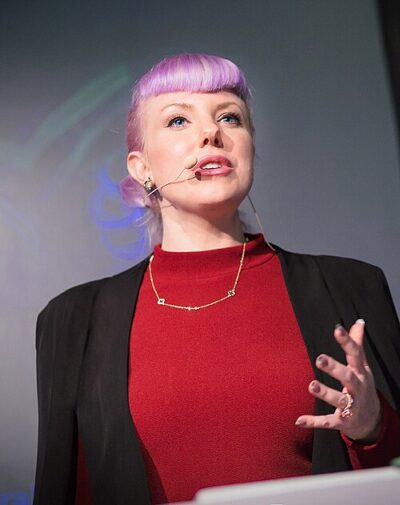
Amy Karle
Amy Karle is an American bioartist. Born 1980, in New York City. Educated at Alfred University and California College of the Arts. Awards include BBC 100 Women.
Facts
14 facts · 0 confirmed by two sources · 8 cited · 6 from one source
Where this comes from
Papalocal keeps its own record. It started from these sources; what each one said is kept here as it was copied, so a change on their side never changes this page by itself. Tap one to read its version.
What Wikidata says · copied November 18, 2026 · revision 2507989201
- Described as
- American bioartist
- Born
- 1980 · 1 reference
- Born in
- New York City · 1 reference
- Citizen of
- United States
- Occupation
- artist · 1 reference; contemporary artist; bioartist; philosopher
- Education
- Alfred University; California College of the Arts · 1 reference; Cornell University · 1 reference
- Awards
- BBC 100 Women (2019) · 1 reference
- Lived in
- San Francisco · 1 reference; Endicott · 1 reference
- Website
- https://www.amykarle.com/
- Wikipedias with a page
- 14
Wikidata item Q71203000 (wikidata.org/wiki/Q71203000), public domain (CC0). Copied November 18, 2026.
What Wikipedia says · copied November 18, 2026 · revision 1367297866
Amy Karle (born 1980) is an American artist, bioartist, and futurist whose work focuses on the relationship between technology and humanity, specifically how technology and biotechnology impact health, humanity, society, evolution, and the future. Karle combines science and technology with art and is known for using living tissue in her work.
In 2018, Karle was an Artist Diplomat sponsored by the U.S. Department of State, for a cultural exchange initiative in conjunction with the Copernicus Science Center in Poland where she led workshops focusing on women's empowerment in STEAM fields. In 2019, she was named one of the BBC's 100 women.
From the Wikipedia article “Amy Karle” (en.wikipedia.org/wiki/Amy_Karle), by its contributors, under CC BY-SA 4.0 (creativecommons.org/licenses/by-sa/4.0/). Copied November 18, 2026; not changed.
Confirmed Two sources agree. Cited One source, and it names where it got it. One source One source, without a reference of its own. Sources disagree The sources disagree. We show the best-supported value and keep theirs below.
