
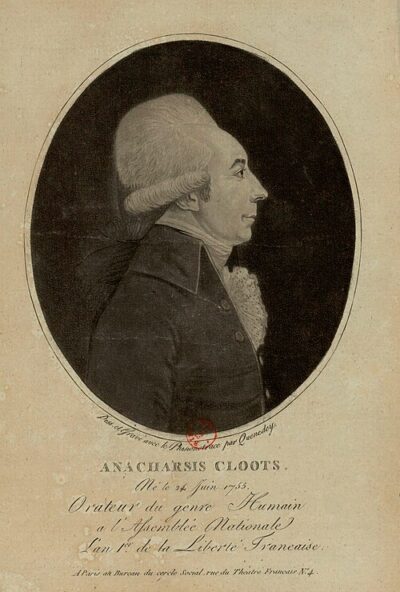
Anacharsis Cloots
Anacharsis Cloots was a Prussian noble. Born June 24, 1755, in Kleve. Died March 24, 1794, in Paris. Positions held include deputy to the National Convention (1792–1793).
Facts
11 facts · 2 confirmed by two sources · 2 cited · 7 from one source
Where this comes from
Papalocal keeps its own record. It started from these sources; what each one said is kept here as it was copied, so a change on their side never changes this page by itself. Tap one to read its version.
What Wikidata says · copied November 18, 2026 · revision 2558967450
- Described as
- Prussian noble (1755-1794)
- Other names
- Baron de Cloots Jean-Baptiste du Val-de-Grâce Cloots, Baron de Cloots Jean-Baptiste du Val-de-Grace Cloots, Jean-Baptiste du Val-de-Grâce, baron de Cloots, Anacharsis Clootz, Jean-Baptiste Cloots
- Born
- June 24, 1755 · 7 references
- Died
- March 24, 1794 · 7 references
- Born in
- Kleve
- Died in
- Paris · 2 references
- Cause of death
- decapitation
- Name at birth
- Jean-Baptiste Cloots
- Citizen of
- France
- Occupation
- politician · 1 reference
- Positions held
- deputy to the National Convention (1792–1793)
- Political party
- Hébertists
- Religion
- atheism
- Wikipedias with a page
- 24
Wikidata item Q483405 (wikidata.org/wiki/Q483405), public domain (CC0). Copied November 18, 2026.
What Wikipedia says · copied November 18, 2026 · revision 1356943909
Jean-Baptiste du Val-de-Grâce, baron de Cloots (24 June 1755 – 24 March 1794), better known as Anacharsis Cloots (also spelled Clootz), was a Prussian nobleman who was a significant figure in the French Revolution. Perhaps the first to advocate a world parliament, an idea later espoused by Albert Camus and Albert Einstein, he was a world federalist and an internationalist anarchist.
According to Siegfried Weichlein, he was nicknamed "orator of mankind", "citizen of humanity" and "a personal enemy of God". However, only the title of "Orator of the Human Race" is one that Cloots actually did give himself with a specific rhetorical meaning in the classical republican tradition of the revolutionaries; it was a way to participate in the French Revolution despite not holding a French citizenship and to mock the official "representative" of his own country, seen as only representing the king and not the people for Cloots. American author Herman Melville refers to an "Anacharsis Clootz deputation" as a representation of global humanity in both Moby-Dick (1851), The Confidence-Man, and later in Billy Budd.
- Born, in its opening lines
- June 24, 1755
- Died, in its opening lines
- March 24, 1794
From the Wikipedia article “Anacharsis Cloots” (en.wikipedia.org/wiki/Anacharsis_Cloots), by its contributors, under CC BY-SA 4.0 (creativecommons.org/licenses/by-sa/4.0/). Copied November 18, 2026; not changed.
Confirmed Two sources agree. Cited One source, and it names where it got it. One source One source, without a reference of its own. Sources disagree The sources disagree. We show the best-supported value and keep theirs below.
