
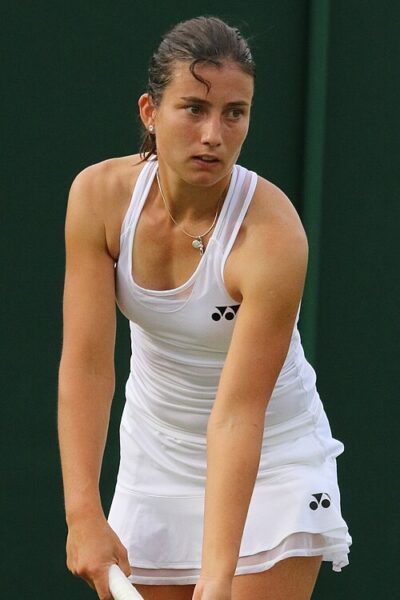
Anastasija Sevastova
Anastasija Sevastova is a Latvian female tennis player. Born April 13, 1990, in Liepāja.
Facts
7 facts · 1 confirmed by two sources · 3 cited · 3 from one source
Where this comes from
Papalocal keeps its own record. It started from these sources; what each one said is kept here as it was copied, so a change on their side never changes this page by itself. Tap one to read its version.
What Wikidata says · copied November 16, 2026 · revision 2570497180
- Described as
- Latvian female tennis player (born 1990)
- Born
- April 13, 1990 · 1 reference
- Born in
- Liepāja · 1 reference
- Citizen of
- Latvia · 1 reference
- Occupation
- tennis player (2006–) · 1 reference
- Sport
- tennis · 1 reference
- Lived in
- Vienna
- Height
- 1.69 m (5 ft 7 in)
- Wikipedias with a page
- 33
Wikidata item Q232445 (wikidata.org/wiki/Q232445), public domain (CC0). Copied November 16, 2026.
What Wikipedia says · copied November 16, 2026 · revision 1381435511
Anastasija Sevastova (born 13 April 1990) is a Latvian former professional tennis player. She achieved a career-high singles ranking of world No. 11 in October 2018, after reaching a Premier Mandatory final at the China Open. Sevastova won four singles titles on the WTA Tour, as well as 13 singles and four doubles titles on the ITF Circuit.
Sevastova is best known for her success at the US Open, particularly during the second half of her career. In 2016, she defeated the reigning French Open champion and world No. 3, Garbiñe Muguruza, as well as Australian Open semifinalist Johanna Konta, en route to her first major quarterfinal. In 2018, she reached her first major semifinal, defeating defending champion and world No. 3, Sloane Stephens (whom she had lost to at that same stage in 2017), in the quarterfinals, before losing to Serena Williams.
- Born, in its opening lines
- April 13, 1990
From the Wikipedia article “Anastasija Sevastova” (en.wikipedia.org/wiki/Anastasija_Sevastova), by its contributors, under CC BY-SA 4.0 (creativecommons.org/licenses/by-sa/4.0/). Copied November 16, 2026; not changed.
Confirmed Two sources agree. Cited One source, and it names where it got it. One source One source, without a reference of its own. Sources disagree The sources disagree. We show the best-supported value and keep theirs below.
