
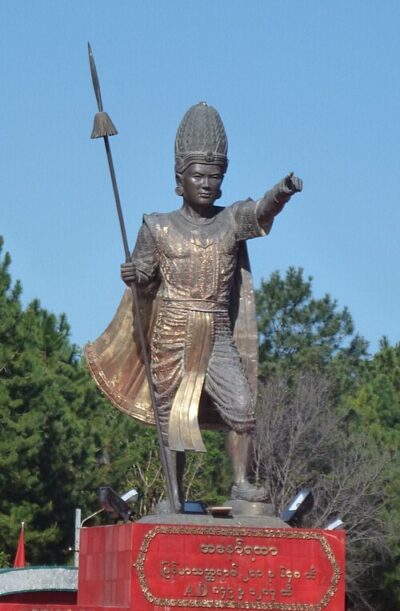
Anawrahta was a founder of the Pagan Empire. Born May 11, 1014, in Bagan. Died April 11, 1077, in Bagan. Positions held include King of Burma (1044–1077).
Facts
15 facts · 2 confirmed by two sources · 1 cited · 12 from one source
Where this comes from
Papalocal keeps its own record. It started from these sources; what each one said is kept here as it was copied, so a change on their side never changes this page by itself. Tap one to read its version.
What Wikidata says · copied November 16, 2026 · revision 2553969231
- Described as
- founder of the Pagan Empire
- Other names
- Anawrahta Minsaw
- Born
- May 11, 1014
- Died
- April 11, 1077
- Born in
- Bagan
- Died in
- Bagan
- Occupation
- king (1044) · 1 reference
- Positions held
- King of Burma (1044–1077)
- Spouse
- Agga Mahethi of Pagan; Pyinsa Kalayani · 1 reference; Manisanda; Saw Mon Hla
- Children
- Sawlu; Kyansittha
- Father
- Kunhsaw Kyaunghpyu
- Mother
- Myauk Pyinthe
- Religion
- Theravāda
- Wikipedias with a page
- 28
Wikidata item Q45241 (wikidata.org/wiki/Q45241), public domain (CC0). Copied November 16, 2026.
What Wikipedia says · copied November 16, 2026 · revision 1385224843
Anawrahta Minsaw (Burmese: အနော်ရထာ မင်းစော, pronounced [ʔənɔ̀jətʰà mɪ́ɰ̃ sɔ́]; 11 May 1014 – 11 April 1077) was the founder of the Pagan Empire. Considered the father of the Burmese nation, Anawrahta turned a small principality in the dry zone of Upper Burma into the first Burmese Empire that formed the basis of modern-day Burma (Myanmar). Historically verifiable Burmese history begins with his accession to the Pagan throne in 1044.
Anawrahta unified the entire Irrawaddy valley for the first time in history, and placed peripheral regions such as the Shan States and Arakan (Rakhine) under Pagan's suzerainty. He successfully stopped the advance of the Khmer Empire into the Tenasserim coastline and into the Upper Menam valley, making Pagan one of the two great kingdoms in mainland Southeast Asia.
A strict disciplinarian, Anawrahta implemented a series of key social, religious and economic reforms that would have a lasting impact in Burmese history. His social and religious reforms later developed into the modern-day Burmese culture. By building a series of weirs, he turned parched, arid regions around Pagan into the main rice granaries of Upper Burma, giving Upper Burma an enduring economic base from which to dominate the Irrawaddy valley and its periphery in the following centuries. He bequeathed a strong administrative system that all later Pagan kings followed until the dynasty's fall in 1287. The success and longevity of Pagan's dominance over the Irrawaddy valley laid the foundation for the ascent of Burmese language and culture, the spread of Burman ethnicity in Upper Burma.
Anawrahta's legacy went far beyond the borders of modern Burma. His embrace of Theravada Buddhism and his success in stopping the advance of Khmer Empire, a Mahayana state, provided the Buddhist school, which had been in retreat elsewhere in South and Southeast Asia, a much needed reprieve and a safe shelter. The success of Pagan dynasty made Theravada Buddhism's later growth in Lan Na (northern Thailand), Siam (central Thailand), Lan Xang (Laos), and Khmer Empire (Cambodia) in the 13th and 14th centuries possible.
Anawrahta is one of the most famous kings in Burmese history. His life stories (legends) are a staple of Burmese folklore and retold in popular literature and theater.
- Born, in its opening lines
- May 11, 1014
- Died, in its opening lines
- April 11, 1077
From the Wikipedia article “Anawrahta” (en.wikipedia.org/wiki/Anawrahta), by its contributors, under CC BY-SA 4.0 (creativecommons.org/licenses/by-sa/4.0/). Copied November 16, 2026; not changed.
Confirmed Two sources agree. Cited One source, and it names where it got it. One source One source, without a reference of its own. Sources disagree The sources disagree. We show the best-supported value and keep theirs below.
