
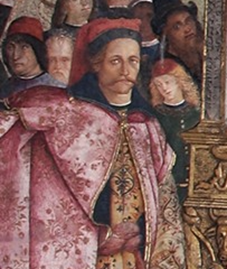
Andreas Palaiologos was a Prince of the Palaiologos dynasty. Born January 17, 1453, in Despotate of the Morea. Died June 1502, in Rome.
Facts
14 facts · 2 confirmed by two sources · 2 cited · 10 from one source
Where this comes from
Papalocal keeps its own record. It started from these sources; what each one said is kept here as it was copied, so a change on their side never changes this page by itself. Tap one to read its version.
What Wikidata says · copied November 18, 2026 · revision 2528202645
- Described as
- Prince of the Palaiologos dynasty
- Born
- January 17, 1453
- Died
- June 1502
- Born in
- Despotate of the Morea
- Died in
- Rome
- Buried in
- Rome · 1 reference
- Occupation
- pretender · 1 reference
- Spouse
- Caterina Paleóloga
- Children
- Maria Palaiologina · 1 reference; Fernando Palaiologos
- Father
- Thomas Palaiologos
- Mother
- Catherine Zaccaria
- Siblings
- Sophia Palaiologina · 1 reference; Helena Palaiologina of the Morea; Manuel Palaiologos
- Wikipedias with a page
- 24
Wikidata item Q499876 (wikidata.org/wiki/Q499876), public domain (CC0). Copied November 18, 2026.
What Wikipedia says · copied November 18, 2026 · revision 1383851907
Andreas Palaiologos (Greek: Ἀνδρέας Παλαιολόγος; 17 January 1453 – June 1502), sometimes anglicized to Andrew Palaeologus, was the eldest son of Thomas Palaiologos, Despot of the Morea. Thomas was a brother of Constantine XI Palaiologos, the final Byzantine emperor. After his father's death in 1465, Andreas was recognized as the titular Despot of the Morea and from 1483 onwards, he also claimed the title "Emperor of Constantinople" (Latin: Imperator Constantinopolitanus).
After the fall of Constantinople in 1453 and the subsequent Ottoman invasion of the Morea in 1460, Andreas's father fled to Corfu with his family. After Thomas died in 1465, the then twelve-year-old Andreas moved to Rome and, as the eldest nephew of Constantine XI, became the head of the Palaiologos family and the chief claimant to the ancient imperial throne. Andreas's later use of the imperial title, never claimed by his father, was supported by some of the Byzantine refugees who lived in Italy and he hoped to one day restore the empire of his ancestors. Andreas married a Roman woman called Caterina. Though some primary sources allude to the possibility that he had children, there is no concrete evidence that Andreas left any descendants.
As his stay in Rome continued, Andreas fell deeper into poverty. Although historians often blame his impoverished situation on a supposedly extravagant and irresponsible lifestyle, a more likely explanation is that the pension and funding provided to him by the papacy were regularly reduced. Andreas traveled around Europe several times in search of a ruler who could aid him in retaking Constantinople but rallied little support. The Ottoman Sultan Mehmed II, who had conquered Constantinople in 1453, died in 1481, and his two sons Cem and Bayezid fought a civil war over who would succeed him. Seeing his opportunity, Andreas attempted to organize an expedition in southern Italy during the summer of 1481 to cross the Adriatic Sea and restore the Byzantine Empire. The excursion was canceled in the autumn after Bayezid had successfully stabilized his rule. Although Andreas maintained hope of recapturing at least the Morea throughout his life, he never returned to Greece.
Desperate for money, Andreas sold his rights to the Byzantine crown in 1494 to Charles VIII of France, who attempted to organize a crusade against the Ottomans. The sale was conditional on Charles, who Andreas hoped to use as a champion against the Ottomans, conquering the Morea and granting it to Andreas. When Charles died in 1498, Andreas once again claimed the imperial titles, using them until his death. He died in poverty in Rome in 1502 and was buried in St. Peter's Basilica. In his will, he granted his titles to Ferdinand II of Aragon and Isabella I of Castile, neither of whom used them.
- Born, in its opening lines
- January 17, 1453
- Died, in its opening lines
- June 1502
From the Wikipedia article “Andreas Palaiologos” (en.wikipedia.org/wiki/Andreas_Palaiologos), by its contributors, under CC BY-SA 4.0 (creativecommons.org/licenses/by-sa/4.0/). Copied November 18, 2026; not changed.
Confirmed Two sources agree. Cited One source, and it names where it got it. One source One source, without a reference of its own. Sources disagree The sources disagree. We show the best-supported value and keep theirs below.
