
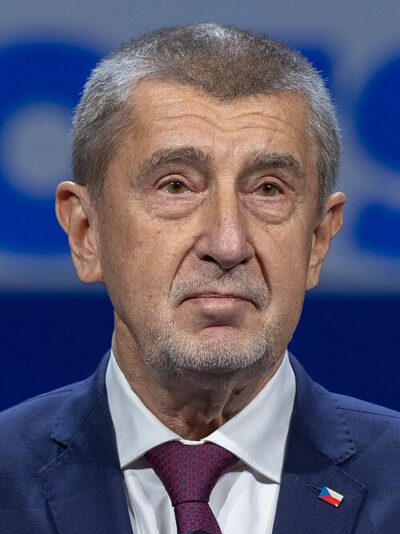
Andrej Babiš
Andrej Babiš is a Czech politician and businessman, Prime Minister of the Czech Republic. Born September 2, 1954, in Bratislava. Positions held include Deputy Prime Minister of the Czech Republic (2014–2017), Finance Minister of the Czech Republic (2014–2017) and Prime Minister of the Czech Republic (2 times) (2017–). Educated at University of Economics in Bratislava. Awards include Boulder Prize and Dostyk Order of grade I.
Facts
32 facts · 1 confirmed by two sources · 18 cited · 13 from one source
Where this comes from
Papalocal keeps its own record. It started from these sources; what each one said is kept here as it was copied, so a change on their side never changes this page by itself. Tap one to read its version.
What Wikidata says · copied November 16, 2026 · revision 2565393792
- Described as
- Czech politician and businessman, Prime Minister of the Czech Republic
- Other names
- Andrej Babis
- Born
- September 2, 1954 · 8 references
- Born in
- Bratislava · 4 references
- Citizen of
- Czechoslovakia (–1992) · 1 reference; Slovakia (1993–); Czech Republic (2000–) · 1 reference
- Occupation
- businessperson · 1 reference; politician · 2 references; economist · 1 reference; entrepreneur · 1 reference; head of government · 1 reference; founder · 1 reference; engineer · 1 reference; minister · 1 reference
- Positions held
- Deputy Prime Minister of the Czech Republic (2014–2017); Finance Minister of the Czech Republic (2014–2017); Prime Minister of the Czech Republic (2 times) (2017–) · 1 reference; member of the chamber of deputies of the parliament of the Czech Republic (2013–) · 1 reference
- Political party
- Communist Party of Czechoslovakia (1980–1989); ANO 2011 (2012–) · 2 references
- Worked for
- Agrofert
- Education
- University of Economics in Bratislava
- Awards
- Boulder Prize · 1 reference; Dostyk Order of grade I (2026) · 1 reference
- Spouse
- Monika Babišová (2017–) · 1 reference; Beata Adamovičová
- Children
- Andrej Babiš Jr.; Adriana Bobeková; Vivien Babišová; Frederik Babiš
- Father
- Štefan Babiš · 1 reference
- Siblings
- Alexander Babiš
- Lived in
- Průhonice · 1 reference
- Wikipedias with a page
- 68
Wikidata item Q10819807 (wikidata.org/wiki/Q10819807), public domain (CC0). Copied November 16, 2026.
What Wikipedia says · copied November 16, 2026 · revision 1385754250
Andrej Babiš (born 2 September 1954) is a Czech politician and businessman who has been the prime minister of the Czech Republic since December 2025, having previously served as prime minister from 2017 to 2021. Prior to that, he was the minister of finance and deputy prime minister from 2014 to 2017. A populist, Babiš has led the ANO 2011 political party since he founded it in 2012.
Born in Bratislava, Babiš moved to the Czech Republic in the early 1990s. During a lengthy business career, he became one of the wealthiest individuals in the Czech Republic, with an estimated net worth of about $4.04 billion according to Bloomberg in November 2020. In September 2026, Forbes estimated his net worth to be $4.2 billion. Babiš made most of his fortune as the founder and owner of Agrofert, one of the country's largest holding companies.
On 6 December 2017, Babiš was appointed prime minister of the Czech Republic, after ANO won the largest share of the vote in the 2017 Czech parliamentary election. When he took office, he was the oldest and wealthiest person ever to become Czech prime minister, as well as the first from a party other than the Civic Democratic Party or the Social Democratic Party. Additionally, Babiš was also the first prime minister born outside the Czech Republic, the first to hold dual citizenship, and the first whose native language is not Czech.
Babiš's political allies during his time as prime minister were President Miloš Zeman, the Czech Social Democratic Party, and the Communist Party. His administration raised the retirement age and reduced pensions, while increasing child tax credits and the salaries of senior politicians. Major political events of his term include the expulsion of over 80 Russian diplomats and resident spies following the disclosure of Russian involvement in the 2014 Vrbětice explosions, and the COVID-19 pandemic, which killed around 35,000 people in the Czech Republic, triggering criticism of the government's response. His time in office was also marked by legal disputes with the European Commission due to accusations of conflict of interest and allegations of EU subsidy fraud. Babiš was succeeded as prime minister by Petr Fiala on 17 December 2021, following the 2021 election. Babiš was a candidate in the 2023 Czech presidential election and lost in the second round to Petr Pavel. He led his ANO movement into the 2025 election as its nominee for prime minister, in which the party placed first with 34.5% of the votes. On 27 October 2025, he was formally tasked by President Pavel to form a government. After forming a coalition government with SPD and a new right-wing party Motorists for Themselves (AUTO), Babiš was appointed prime minister on 9 December. His cabinet took power on 15 December 2025.
Following allegations that an anonymous company he controlled unlawfully received a €2M subsidy from the European Regional Development Fund, Babiš was investigated by both the Czech police and the European Anti-Fraud Office (OLAF) from 2015 to 2017. He was stripped of his parliamentary immunity and formally charged on 9 October 2017. He was acquitted of the charges in January 2023, but the verdict was overturned and remanded in November 2023. Babiš has received sustained criticism over a number of issues, including alleged conflicts of interest, his past role in the StB, and allegations of intimidating political opponents. Babiš remains one of the most popular and divisive politicians in the Czech Republic.
- Born, in its opening lines
- September 2, 1954
From the Wikipedia article “Andrej Babiš” (en.wikipedia.org/wiki/Andrej_Babiš), by its contributors, under CC BY-SA 4.0 (creativecommons.org/licenses/by-sa/4.0/). Copied November 16, 2026; not changed.
Confirmed Two sources agree. Cited One source, and it names where it got it. One source One source, without a reference of its own. Sources disagree The sources disagree. We show the best-supported value and keep theirs below.
