
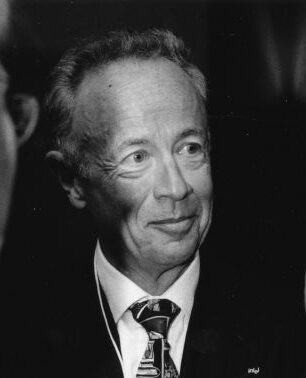
Andrew Grove
Andrew Grove was a Hungarian-born American businessman, engineer and author. Born September 2, 1936, in Budapest. Died March 21, 2016, in Los Altos. Positions held include president (1979–1987), président-directeur général (1987–1997) and chairperson of the executive board (1997–2004). Educated at University of California, Berkeley and City University of New York. Awards include IEEE Ernst Weber Engineering Leadership Recognition, J. J. Ebers Award and IEEE Medal of Honor.
Facts
37 facts · 2 confirmed by two sources · 12 cited · 22 from one source · 1 where the sources disagree
What’s different
- Born in: we show Budapest (Sources disagree). Wikidata also lists United States
Where this comes from
Papalocal keeps its own record. It started from these sources; what each one said is kept here as it was copied, so a change on their side never changes this page by itself. Tap one to read its version.
What Wikidata says · copied November 14, 2026 · revision 2563204811
- Described as
- Hungarian-born American businessman, engineer and author (1936–2016)
- Other names
- Andrew Stephen Grove, Andy Grove, András István Gróf, Andras Istvan Grof
- Born
- September 2, 1936 · 2 references
- Died
- March 21, 2016 · 4 references
- Born in
- Budapest · 1 reference; United States · 1 reference
- Died in
- Los Altos · 1 reference
- Cause of death
- Parkinson's disease
- Name at birth
- Gróf András István
- Citizen of
- United States; Hungary
- Occupation
- engineer; entrepreneur · 1 reference; writer · 1 reference; professor; scientist · 1 reference
- Positions held
- president (1979–1987); président-directeur général (1987–1997); chairperson of the executive board (1997–2004)
- Worked for
- Intel (1968–2004); Fairchild Semiconductor (–1968); Stanford University
- Education
- University of California, Berkeley (–1963); City University of New York (–1960) · 1 reference
- Member of
- American Academy of Arts and Sciences; National Academy of Engineering
- Awards
- IEEE Ernst Weber Engineering Leadership Recognition; J. J. Ebers Award (1974) · 1 reference; IEEE Medal of Honor (2000) · 1 reference; California Hall of Fame (2009); Heinz Award (1994) · 1 reference; Time Person of the Year (1997); Great Immigrants Award (2006) · 1 reference; Neumann Plaque of the John von Neumann Computer Society (1995) · 1 reference
- Field
- computer engineering; chemical engineering; semiconductor · 1 reference; electronic component · 1 reference; computer industry · 1 reference; management · 1 reference
- Wikipedias with a page
- 39
Wikidata item Q432929 (wikidata.org/wiki/Q432929), public domain (CC0). Copied November 14, 2026.
What Wikipedia says · copied November 14, 2026 · revision 1384314196
Andrew "Andy" Stephen Grove (born Gróf András István; 2 September 1936 – 21 March 2016) was a Hungarian-American businessman and engineer who served as the third CEO of Intel Corporation. He left Hungary during the 1956 revolution at the age of 20 and moved to the United States, where he finished his education. He was the third employee and eventual third CEO of Intel, transforming the company into the world's largest semiconductor company.
As a result of his work at Intel, along with his books and professional articles, Grove had a considerable influence on the electronics manufacturing industries worldwide. He has been called the "guy who drove the growth phase" of Silicon Valley. In 1997, Time magazine chose him as "Man of the Year", for being "the person most responsible for the amazing growth in the power and the innovative potential of microchips." One source notes that by his accomplishments at Intel alone, he "merits a place alongside the great business leaders of the 20th century."
- Born, in its opening lines
- September 2, 1936
- Died, in its opening lines
- March 21, 2016
From the Wikipedia article “Andrew Grove” (en.wikipedia.org/wiki/Andrew_Grove), by its contributors, under CC BY-SA 4.0 (creativecommons.org/licenses/by-sa/4.0/). Copied November 14, 2026; not changed.
Confirmed Two sources agree. Cited One source, and it names where it got it. One source One source, without a reference of its own. Sources disagree The sources disagree. We show the best-supported value and keep theirs below.
