
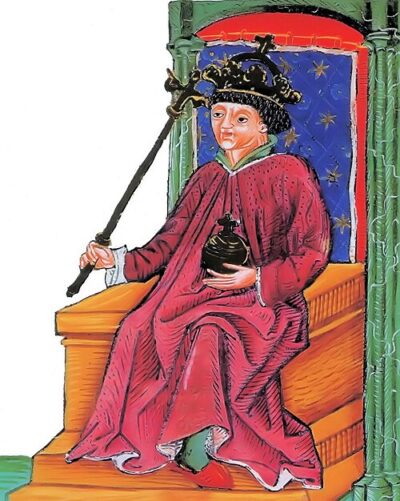
Andrew III of Hungary
Andrew III of Hungary was a King of Hungary and Croatia between 1290 and 1301. Born 1265, in Venice. Died January 14, 1301, in Buda. Positions held include Apostolic King of Hungary (1290–1301).
Facts
14 facts · 2 confirmed by two sources · 5 cited · 7 from one source
Where this comes from
Papalocal keeps its own record. It started from these sources; what each one said is kept here as it was copied, so a change on their side never changes this page by itself. Tap one to read its version.
What Wikidata says · copied November 16, 2026 · revision 2564424949
- Described as
- King of Hungary and Croatia between 1290 and 1301
- Other names
- Andrew III the Venetian, Andrew III, Andreas III Arpád, King of Hungary
- Born
- 1265 · 2 references
- Died
- January 14, 1301 · 2 references
- Born in
- Venice · 1 reference
- Died in
- Buda
- Buried in
- Székesfehérvár
- Citizen of
- Hungary
- Occupation
- politician
- Positions held
- Apostolic King of Hungary (1290–1301) · 2 references
- Political party
- politician before the emergence of political parties
- Spouse
- Fenenna of Kuyavia (1290–1295) · 1 reference; Agnes of Austria (1296–) · 1 reference
- Children
- Elizabeth of Töss · 1 reference
- Father
- Stephen the Posthumous · 1 reference
- Mother
- Tomasina Morosini · 1 reference
- Wikipedias with a page
- 43
Wikidata item Q298056 (wikidata.org/wiki/Q298056), public domain (CC0). Copied November 16, 2026.
What Wikipedia says · copied November 16, 2026 · revision 1367690347
Andrew III the Venetian (Hungarian: III. Velencei András, Croatian: Andrija III. Mlečanin, Slovak: Ondrej III., Italian: Andrea III il veneziano; c. 1265 – 14 January 1301) was King of Hungary and Croatia between 1290 and 1301. His father, Stephen the Posthumous, was the posthumous son of Andrew II of Hungary although Stephen's older half brothers considered him a bastard. Andrew grew up in Venice, and first arrived in Hungary upon the invitation of a rebellious baron, Ivan Kőszegi, in 1278. Kőszegi tried to play Andrew off against Ladislaus IV of Hungary, but the conspiracy collapsed and Andrew returned to Venice.
Being the last male member of the House of Árpád, Andrew was elected king after the death of King Ladislaus IV in 1290. He was the first Hungarian monarch to issue a coronation diploma confirming the privileges of the noblemen and the clergy. At least three pretenders—Albert of Austria, Mary of Hungary, and an adventurer—challenged his claim to the throne. Andrew expelled the adventurer from Hungary and forced Albert of Austria to conclude a peace within a year, but Mary of Hungary and her descendants did not renounce their claim. The Hungarian bishops and Andrew's maternal family from Venice were his principal supporters, but the leading Croatian and Slavonian lords were opposed to his rule.
Hungary was in a state of constant anarchy during Andrew's reign. The Kőszegis, the Csáks, and other powerful families autonomously governed their domains, rising up nearly every year in open rebellion against Andrew. With Andrew's death, the House of Árpád became extinct. A civil war ensued which lasted for more than two decades and ended with the victory of Mary of Hungary's grandson, Charles Robert.
- Born, in its opening lines
- c. 1265
- Died, in its opening lines
- January 14, 1301
From the Wikipedia article “Andrew III of Hungary” (en.wikipedia.org/wiki/Andrew_III_of_Hungary), by its contributors, under CC BY-SA 4.0 (creativecommons.org/licenses/by-sa/4.0/). Copied November 16, 2026; not changed.
Confirmed Two sources agree. Cited One source, and it names where it got it. One source One source, without a reference of its own. Sources disagree The sources disagree. We show the best-supported value and keep theirs below.
