
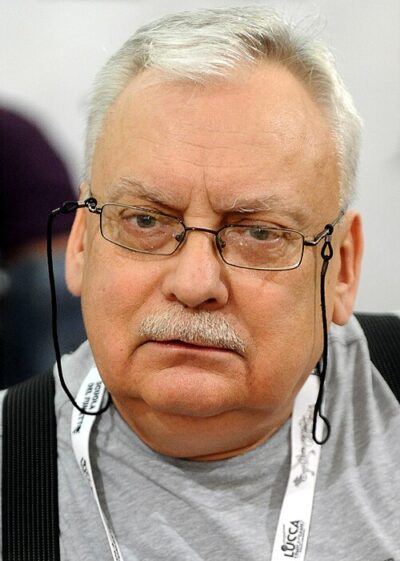
Andrzej Sapkowski
Andrzej Sapkowski is a Polish novelist. Born June 21, 1948, in Łódź. Known for The Witcher, Time of Contempt and The Last Wish. Educated at University of Łódź and XXI Liceum Ogólnokształcące in Łódź. Awards include Silver Medal for Merit to Culture – Gloria Artis, Ignotus Award for Best Anthology and Paszport Polityki.
Facts
30 facts · 1 confirmed by two sources · 3 cited · 26 from one source
Where this comes from
Papalocal keeps its own record. It started from these sources; what each one said is kept here as it was copied, so a change on their side never changes this page by itself. Tap one to read its version.
What Wikidata says · copied November 16, 2026 · revision 2567253101
- Described as
- Polish novelist (born 1948)
- Other names
- A. Sapkowski, Sapkowski, Andrzej
- Born
- June 21, 1948 · 4 references
- Born in
- Łódź · 1 reference
- Citizen of
- Poland
- Occupation
- writer · 1 reference; translator · 1 reference
- Education
- University of Łódź (–1972); XXI Liceum Ogólnokształcące in Łódź · 1 reference
- Member of
- Stowarzyszenie Pisarzy Polskich · 1 reference
- Genre
- fantasy
- Known for
- The Witcher; Time of Contempt; The Last Wish; The Tower of the Swallow; Lady of the Lake; Baptism of Fire
- Awards
- Silver Medal for Merit to Culture – Gloria Artis (2012) · 1 reference; Ignotus Award for Best Anthology (2003) · 1 reference; Paszport Polityki (1997); honorary citizen of Łódź (2008) · 1 reference; Sphinx Award (6 times) (1995, 1997, 1998, 2000, 2005, 2007) · 1 reference; City of Łódź Award (2004) · 1 reference; World Fantasy Awards (2016) · 1 reference; David Gemmell Legend Awards (2009) · 1 reference; Janusz A. Zajdel Award (4 times) (1992, 1993, 1994, 2002) · 1 reference; Tähtifantasia Award (2012) · 1 reference; FantLab's Book of the Year Award (2011) · 1 reference; Ignotus Awards (2003) · 1 reference; Janusz A. Zajdel Story Award (1990) · 1 reference
- Field
- fantasy · 1 reference
- Religion
- atheism · 1 reference
- Wikipedias with a page
- 66
Wikidata item Q312101 (wikidata.org/wiki/Q312101), public domain (CC0). Copied November 16, 2026.
What Wikipedia says · copied November 16, 2026 · revision 1384721449
Andrzej Sapkowski (Polish: [ˈandʐɛj sapˈkɔfski]; born 21 June 1948) is a Polish fantasy writer. He is best known for his series of books The Witcher, which revolves around the eponymous monster hunter, or "witcher", Geralt of Rivia. The saga has been popularized through video games, television, stage, comic books and translated into 37 languages, making him the second most-translated Polish science fiction and fantasy writer after Stanisław Lem.
Described as the "Polish Tolkien", he has written multiple novels and short story collections, selling over 30 million copies worldwide. The influence of Slavic mythology is seen as a characteristic feature of many of his works. He is a six-time recipient of the Zajdel Award, Poland's most popular science fiction and fantasy prize, as well as many other awards and honors including David Gemmell Award, World Fantasy Life Achievement Award and the Gloria Artis Medal for Merit to Culture.
- Born, in its opening lines
- June 21, 1948
From the Wikipedia article “Andrzej Sapkowski” (en.wikipedia.org/wiki/Andrzej_Sapkowski), by its contributors, under CC BY-SA 4.0 (creativecommons.org/licenses/by-sa/4.0/). Copied November 16, 2026; not changed.
Confirmed Two sources agree. Cited One source, and it names where it got it. One source One source, without a reference of its own. Sources disagree The sources disagree. We show the best-supported value and keep theirs below.
