
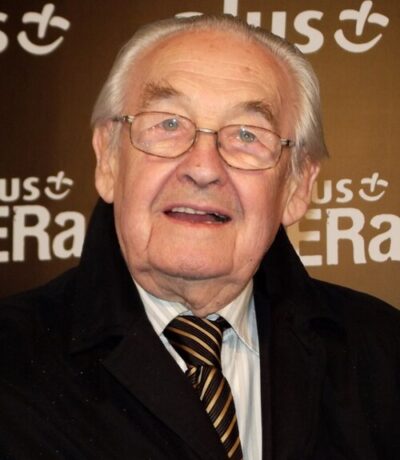
Andrzej Wajda
Andrzej Wajda was a Polish film director. Born March 6, 1926, in Suwałki. Died October 9, 2016, in Warsaw. Positions held include Member of the Senate of the Republic of Poland (1989–1991). Educated at Jan Matejko Academy of Fine Arts in Krakow and National Film School in Łódź. Awards include Commander of the Legion of Honour, Commandeur des Arts et des Lettres and Commander's Cross of the Order of Merit of the Federal Republic of Germany.
Facts
55 facts · 2 confirmed by two sources · 11 cited · 42 from one source
Where this comes from
Papalocal keeps its own record. It started from these sources; what each one said is kept here as it was copied, so a change on their side never changes this page by itself. Tap one to read its version.
What Wikidata says · copied November 16, 2026 · revision 2568003675
- Described as
- Polish film director (1926–2016)
- Other names
- Andrzej Witold Wajda
- Born
- March 6, 1926 · 12 references
- Died
- October 9, 2016 · 9 references
- Born in
- Suwałki · 4 references
- Died in
- Warsaw · 2 references
- Buried in
- Salwator Cemetery
- Cause of death
- respiratory failure
- Citizen of
- Poland · 1 reference
- Occupation
- director · 5 references; screenwriter · 3 references; film director · 2 references; theatre director; film producer · 2 references; television director; politician · 1 reference; painter
- Positions held
- Member of the Senate of the Republic of Poland (1989–1991)
- Political party
- Polish United Workers' Party; Solidarity Citizens' Committee · 1 reference; Citizens Parliamentary Party · 1 reference; Democratic Union · 1 reference
- Worked for
- Top Courses for Scriptwriters and Film Directors; Teatr Powszechny · 1 reference
- Education
- Jan Matejko Academy of Fine Arts in Krakow (1946–1950); National Film School in Łódź (1950–1953)
- Member of
- Academy of Arts, Berlin; American Academy of Arts and Sciences; Polish Film Academy · 1 reference; Stowarzyszenie Filmowców Polskich · 1 reference; Académie des beaux-arts; Polish Academy of Learning · 1 reference
- Awards
- Commander of the Legion of Honour (2001); Commandeur des Arts et des Lettres (2009); Commander's Cross of the Order of Merit of the Federal Republic of Germany (2001); Order of the White Eagle (2011); Golden Medal for Merit to Culture (2005) · 1 reference; Praemium Imperiale (1996) · 1 reference; Order of the Three Stars, 3rd Class (2011); Jury Prize (1957); David di Donatello Luchino Visconti (1978); Palme d'Or (1981); London Film Critics Circle Award for Director of the Year (2 times) (1981, 1983); BAFTA Fellowship (1982); Honorary César (1982); Louis Delluc Prize (1982); César Award for Best Director (1983)
- Field
- film direction · 1 reference
- Spouse
- Beata Tyszkiewicz (1967–1968) · 1 reference; Krystyna Zachwatowicz (1974–2016) · 1 reference; Gabriela Obremba (1949–1959) · 1 reference; Zofia Żuchowska (1959–1967) · 1 reference
- Children
- Karolina Wajda
- Father
- Jakub Wajda
- Siblings
- Leszek Wajda
- Military branch
- Armia Krajowa · 1 reference
- Website
- http://www.wajda.pl
- Wikipedias with a page
- 80
Wikidata item Q106685 (wikidata.org/wiki/Q106685), public domain (CC0). Copied November 16, 2026.
What Wikipedia says · copied November 16, 2026 · revision 1379191681
Andrzej Witold Wajda (Polish: [ˈandʐɛj ˈvajda]; 6 March 1926 – 9 October 2016) was a Polish film and theatre director. Recipient of an Honorary Oscar, the Palme d'Or, as well as Honorary Golden Lion and Honorary Golden Bear Awards, he was a prominent member of the "Polish Film School". He was known especially for his trilogy of war films consisting of A Generation (1955), Kanał (1957) and Ashes and Diamonds (1958).
Considered one of the world's most renowned filmmakers, his works chronicled his native country's political and social evolution and dealt with the myths of Polish national identity, offering analysis of the universal element of the Polish experience – the struggle to maintain dignity under the most trying circumstances.
Four of his films have been nominated for the Academy Award for Best Foreign Language Film: The Promised Land (1975), The Maids of Wilko (1979), Man of Iron (1981) and Katyń (2007).
- Born, in its opening lines
- March 6, 1926
- Died, in its opening lines
- October 9, 2016
From the Wikipedia article “Andrzej Wajda” (en.wikipedia.org/wiki/Andrzej_Wajda), by its contributors, under CC BY-SA 4.0 (creativecommons.org/licenses/by-sa/4.0/). Copied November 16, 2026; not changed.
Confirmed Two sources agree. Cited One source, and it names where it got it. One source One source, without a reference of its own. Sources disagree The sources disagree. We show the best-supported value and keep theirs below.
