
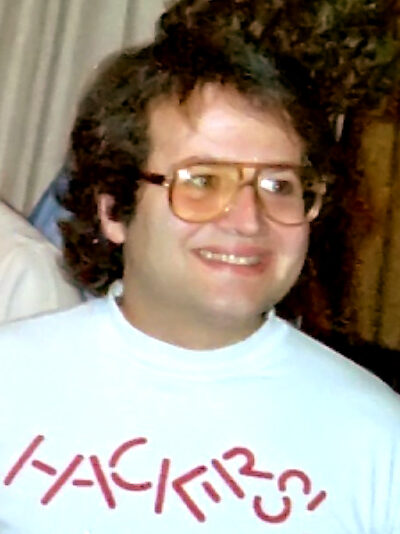
Andy Hertzfeld
Andy Hertzfeld is an American computer scientist and inventor. Born April 6, 1953, in Philadelphia. Educated at Brown University and University of California, Berkeley.
Facts
11 facts · 1 confirmed by two sources · 2 cited · 8 from one source
Where this comes from
Papalocal keeps its own record. It started from these sources; what each one said is kept here as it was copied, so a change on their side never changes this page by itself. Tap one to read its version.
What Wikidata says · copied November 16, 2026 · revision 2562361664
- Described as
- American computer scientist and inventor (born 1953)
- Other names
- Andrew Jay Hertzfeld
- Born
- April 6, 1953
- Born in
- Philadelphia · 1 reference
- Citizen of
- United States
- Occupation
- computer engineer; software developer · 1 reference
- Worked for
- Apple Inc. (1979–1984); Google (2005–2013)
- Education
- Brown University; University of California, Berkeley; Harriton High School · 1 reference
- Website
- https://www.folklore.org/
- Wikipedias with a page
- 23
Wikidata item Q526166 (wikidata.org/wiki/Q526166), public domain (CC0). Copied November 16, 2026.
What Wikipedia says · copied November 16, 2026 · revision 1383143217
Andrew Jay Hertzfeld (born April 6, 1953) is an American software engineer who was a member of Apple Computer's original Macintosh development team during the 1980s. After buying an Apple II in January 1978, he went to work for Apple Computer from August 1979 until March 1984, where he was a designer for the Macintosh system software.
Since leaving Apple, Hertzfeld has co-founded three companies: Radius in 1986, General Magic in 1990, and Eazel in 1999. In 2002, he helped Mitch Kapor promote open-source software with the Open Source Applications Foundation.
Hertzfeld worked at Google from 2005 to 2013, where, in 2011, he was the key designer of the Circles user interface in Google+.
- Born, in its opening lines
- April 6, 1953
From the Wikipedia article “Andy Hertzfeld” (en.wikipedia.org/wiki/Andy_Hertzfeld), by its contributors, under CC BY-SA 4.0 (creativecommons.org/licenses/by-sa/4.0/). Copied November 16, 2026; not changed.
Confirmed Two sources agree. Cited One source, and it names where it got it. One source One source, without a reference of its own. Sources disagree The sources disagree. We show the best-supported value and keep theirs below.
