
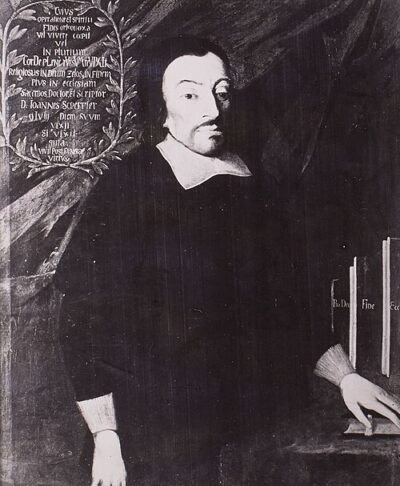
Angelus Silesius
Angelus Silesius was a German-Silesian religious poet, Catholic priest, theologian, and physician. Born December 1624, in Wrocław. Died July 9, 1677, in Wrocław. Known for Cherubinischer Wandersmann. Educated at Leiden University and University of Strasbourg.
Facts
18 facts · 2 confirmed by two sources · 5 cited · 11 from one source
Where this comes from
Papalocal keeps its own record. It started from these sources; what each one said is kept here as it was copied, so a change on their side never changes this page by itself. Tap one to read its version.
What Wikidata says · copied November 16, 2026 · revision 2563973534
- Described as
- German-Silesian religious poet, Catholic priest, theologian, and physician (1624–1677)
- Other names
- Johann Scheffler, Johann Angelus Silesius, Johannes Scheffler, Johannes Scheffer, Silesius, Scheffler
- Born
- December 1624 · 1 reference
- Died
- July 9, 1677 · 6 references
- Born in
- Wrocław · 4 references
- Died in
- Wrocław · 1 reference
- Buried in
- Saint Matthew church in Wrocław
- Name at birth
- Johann Scheffler
- Citizen of
- Archduchy of Austria
- Occupation
- physician writer; poet · 1 reference; writer · 2 references; theologian · 2 references; Catholic priest; physician
- Education
- Leiden University; University of Strasbourg · 1 reference
- Known for
- Cherubinischer Wandersmann
- Religion
- Catholicism; Lutheranism
- Wikipedias with a page
- 46
Wikidata item Q60469 (wikidata.org/wiki/Q60469), public domain (CC0). Copied November 16, 2026.
What Wikipedia says · copied November 16, 2026 · revision 1384917669
Angelus Silesius, OFM (c. 1624 – 9 July 1677), born Johann Scheffler, was a German Catholic priest, physician, mystic and religious poet. Born and raised a Lutheran, he began to read the works of medieval mystics while studying in the Netherlands and became acquainted with the works of the German mystic Jacob Böhme through Böhme's friend Abraham von Franckenberg. Silesius's display of his mystic beliefs caused tension with Lutheran authorities and led to his eventual conversion to Catholicism in 1653, wherein he adopted the name Angelus (Latin for "angel" or "heavenly messenger") and the epithet Silesius ("Silesian"). He entered the Franciscans and was ordained a priest in 1661. Ten years later, in 1671, he retired to a Jesuit house where he remained for the rest of his life.
An enthusiastic convert and priest, Silesius worked to convince German Protestants in Silesia to return to the Catholic Church. He composed 55 tracts and pamphlets condemning Protestantism, several of which were published in two folio volumes entitled Ecclesiologia (i.e., Ecclesiology). However, he is now remembered chiefly for his mystical poetry, and in particular for two poetical works, both published in 1657: Heilige Seelen-Lust (The Soul's Holy Desires), a collection of more than 200 religious hymn texts that have since been used by both Catholics and Protestants; and Cherubinischer Wandersmann ("The Cherubic Pilgrim"), a collection of 1,676 short poems, mostly in Alexandrine couplets. His poetry explores contemporary themes of the greatness of God, mystic interpretations of the Trinity, and the relationship between the soul and Christ. A small number of these couplets seem to savour of quietism or pantheism. They ought to be interpreted in an orthodox Catholic sense, for Angelus Silesius was not a pantheist. His prose writings are orthodox; "The Cherubic Pilgrim" was published with the ecclesiastical Imprimatur, and, in his preface, the author himself explains his "paradoxes" in an orthodox sense, and repudiates any future pantheistic interpretation.
- Born, in its opening lines
- c. 1624
- Died, in its opening lines
- July 9, 1677
From the Wikipedia article “Angelus Silesius” (en.wikipedia.org/wiki/Angelus_Silesius), by its contributors, under CC BY-SA 4.0 (creativecommons.org/licenses/by-sa/4.0/). Copied November 16, 2026; not changed.
Confirmed Two sources agree. Cited One source, and it names where it got it. One source One source, without a reference of its own. Sources disagree The sources disagree. We show the best-supported value and keep theirs below.
