
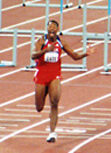
Anier García is a Cuban hurdler. Born March 9, 1976, in Santiago de Cuba.
Facts
6 facts · 1 confirmed by two sources · 0 cited · 5 from one source
Where this comes from
Papalocal keeps its own record. It started from these sources; what each one said is kept here as it was copied, so a change on their side never changes this page by itself. Tap one to read its version.
What Wikidata says · copied November 17, 2026 · revision 2569098749
- Described as
- Cuban hurdler
- Other names
- Anier Garcia
- Born
- March 9, 1976 · 1 reference
- Born in
- Santiago de Cuba
- Citizen of
- Cuba
- Occupation
- athletics competitor
- Sport
- athletics
- Height
- 1.89 m (6 ft 2 in)
- Wikipedias with a page
- 28
Wikidata item Q126581 (wikidata.org/wiki/Q126581), public domain (CC0). Copied November 17, 2026.
What Wikipedia says · copied November 17, 2026 · revision 1380563149
Anier Octavio García Ortiz (born March 9, 1976) is a Cuban track and field athlete, winner of the 110 metres hurdles at the 2000 Summer Olympics.
Born in Santiago de Cuba, Anier García established his credentials early, by winning the 1995 Pan American Junior Championships. In the next year, at the 1996 Summer Olympics, García was eliminated in the quarter-finals.
In 1997, García broke to the international scene by winning 60 m hurdles at the 1997 World Indoor Championships at Paris. At the World Championships in Athens, he competed with a leg injury, and although he finished second in his quarter-final, he withdrew from the semi-finals. In 1999, García won the Pan-American Games, but was beaten second by Colin Jackson at the World Championships.
The high peak of García's career was at the 2000 Sydney Olympics. The Olympic final was expected to be a tight competition amongst the top five hurdlers, but García won the gold medal easily, beating Terrence Trammell by 0.16 seconds. García repeated his silver medal at the 2001 World Championships and also won silver at the 2001 World Indoor Championships and 2003 World Indoor Championships. García did not compete at the 2003 World Championships due to a thigh injury, but at the 2004 Summer Olympics, he won the bronze medal.
- Born, in its opening lines
- March 9, 1976
From the Wikipedia article “Anier García” (en.wikipedia.org/wiki/Anier_García), by its contributors, under CC BY-SA 4.0 (creativecommons.org/licenses/by-sa/4.0/). Copied November 17, 2026; not changed.
Confirmed Two sources agree. Cited One source, and it names where it got it. One source One source, without a reference of its own. Sources disagree The sources disagree. We show the best-supported value and keep theirs below.
