
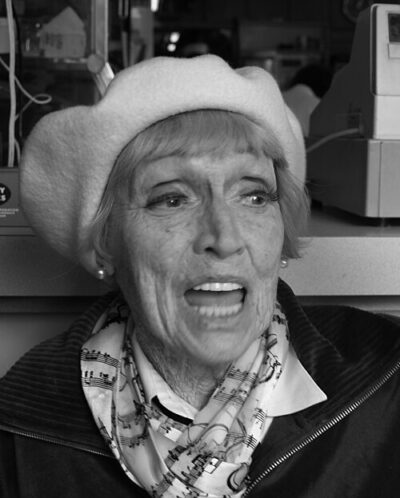
Anita O'Day
Anita O'Day was an American jazz singer. Born October 18, 1919, in Chicago. Died November 23, 2006, in West Hollywood. Educated at Senn High School. Awards include NEA Jazz Masters.
Facts
16 facts · 2 confirmed by two sources · 6 cited · 8 from one source
Where this comes from
Papalocal keeps its own record. It started from these sources; what each one said is kept here as it was copied, so a change on their side never changes this page by itself. Tap one to read its version.
What Wikidata says · copied November 15, 2026 · revision 2563872734
- Described as
- American jazz singer (1919–2006)
- Other names
- Anita Belle Colton
- Born
- October 18, 1919 · 6 references
- Died
- November 23, 2006 · 9 references
- Born in
- Chicago · 1 reference
- Died in
- West Hollywood · 1 reference
- Cause of death
- myocardial infarction
- Name at birth
- Anita Belle Colton
- Citizen of
- United States
- Occupation
- singer; jazz musician; jazz singer · 1 reference; musician · 1 reference
- Education
- Senn High School · 1 reference
- Genre
- jazz · 1 reference
- Instrument
- voice · 1 reference
- Record label
- Verve Records
- Awards
- NEA Jazz Masters
- Wikipedias with a page
- 29
Wikidata item Q234413 (wikidata.org/wiki/Q234413), public domain (CC0). Copied November 15, 2026.
What Wikipedia says · copied November 15, 2026 · revision 1382849222
Anita O'Day (born Anita Belle Colton; October 18, 1919 – November 23, 2006) was an American singer known for her work in the jazz genre. She was considered by writers an influential jazz vocalist for her ability to keep up with fast-tempo arrangements and for her characteristic vocal delivery. Her music has been acclaimed by critics and writers.
O'Day spent her early years as a walkathon contestant before discovering a true calling for her singing. She got her start performing in jazz clubs across Chicago, Illinois, before being discovered by Gene Krupa and his big band. She was hired as their lead vocalist and had US hits with songs like "Let Me off Uptown" (1941). She also was a vocalist for Stan Kenton's band and had her highest-charting US hit with the top-10 "And Her Tears Flowed Like Wine" (1944). She graduated to a solo career in 1947 where she cut records for various labels in a new jazz sub-genre called bebop. However, her use of drugs like marijuana and heroin led to several highly-publicized arrests during this period, including a six-month stint in prison in 1953.
She found success with a series of albums recorded for Verve Records between 1956 and 1964. Her LPs featured orchestras (as on 1956's Anita) and quartets, as on 1958's Anita Sings the Most. A notable performance at the Newport Jazz Festival in 1958 brought great attention to her music and career. A continued addiction to heroin led to a near-fatal overdose in 1966 that prompted O'Day to turn her life around. After getting sober, she reignited her career in the 1970s by touring in Japan and founding her own record label. A new manager, Alan Eichler, helped elevate her publicity and she made a series of US television appearances on programs like 60 Minutes and The Tonight Show Starring Johnny Carson.
In 1981, O'Day's autobiography High Times Hard Times was published, chronicling her professional and personal setbacks. Her career continued during the decade with a series of albums on her own labels and in performances such as her 50th-anniversary concert at Carnegie Hall (1985). In 1996, the mistreatment of a broken arm led to O'Day developing pneumonia and nearly dying. She made a full recovery by 1999 and continued performing in concert into the 2000s decade. Her final album, Indestructible!, was released in 2006. A documentary about her life and career, titled Anita O'Day: The Life of a Jazz Singer, premiered after her death in 2007.
- Born, in its opening lines
- October 18, 1919
- Died, in its opening lines
- November 23, 2006
From the Wikipedia article “Anita O'Day” (en.wikipedia.org/wiki/Anita_O'Day), by its contributors, under CC BY-SA 4.0 (creativecommons.org/licenses/by-sa/4.0/). Copied November 15, 2026; not changed.
Confirmed Two sources agree. Cited One source, and it names where it got it. One source One source, without a reference of its own. Sources disagree The sources disagree. We show the best-supported value and keep theirs below.
