
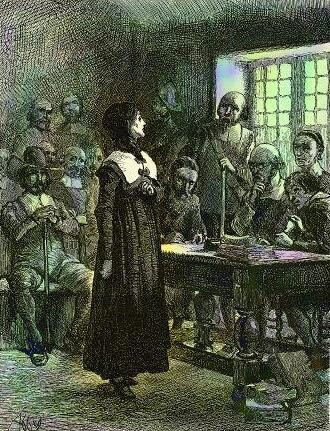
Anne Hutchinson
Anne Hutchinson was a participant in the Antinomian Controversy. Born July 1591, in Alford. Died August 1643, in New Netherland. Educated at homeschooling. Awards include National Women's Hall of Fame and Rhode Island Heritage Hall of Fame Women inductee.
Facts
24 facts · 2 confirmed by two sources · 8 cited · 14 from one source
Where this comes from
Papalocal keeps its own record. It started from these sources; what each one said is kept here as it was copied, so a change on their side never changes this page by itself. Tap one to read its version.
What Wikidata says · copied November 16, 2026 · revision 2569099300
- Described as
- participant in the Antinomian Controversy
- Other names
- Anne Marbury Hutchinson, Anne Marbury, Ann Marbury
- Born
- July 1591 · 1 reference
- Died
- August 1643 · 1 reference
- Born in
- Alford
- Died in
- New Netherland · 1 reference
- Name at birth
- Anne Marbury
- Citizen of
- Kingdom of England
- Occupation
- midwife; theologian · 1 reference; preacher; writer · 1 reference
- Worked for
- merchant
- Education
- homeschooling
- Awards
- National Women's Hall of Fame (1994) · 1 reference; Rhode Island Heritage Hall of Fame Women inductee
- Spouse
- William Hutchinson · 2 references
- Children
- Edward Hutchinson · 1 reference; Susanna Hutchinson; Bridget Hutchinson; Faith Hutchinson · 2 references
- Father
- Francis Marbury
- Mother
- Bridget Dryden · 1 reference
- Siblings
- Katherine Marbury Scott
- Religion
- Protestantism
- Website
- https://www.annehutchinson.com
- Wikipedias with a page
- 37
Wikidata item Q11608 (wikidata.org/wiki/Q11608), public domain (CC0). Copied November 16, 2026.
What Wikipedia says · copied November 16, 2026 · revision 1385449673
Anne Hutchinson (née Marbury; July 1591 – August 1643) was an English-born religious figure who emigrated with her family from England to the New World. She was an important participant in the Antinomian Controversy that shook the nascent Massachusetts Bay Colony from 1636 to 1638. Her strong religious formal declarations were at odds with the established Puritan clergy in the Boston area and her popularity and charisma helped create a theological schism that threatened the Puritan religious community there.
She was eventually tried and convicted, and banished from the colony along with many of her supporters. Five years after her banishment, she and several members of her family and household were killed in a massacre committed by Native Americans in New Netherland, where the household had moved.
Hutchinson was born in Alford, Lincolnshire, the daughter of Francis Marbury and his wife. He was an Anglican cleric and school teacher who gave her a far better education than most other girls received. She lived in London as a young adult, and there married a friend from home, William Hutchinson. The couple moved back to Alford where they began following the preacher John Cotton in the large, nearby port of Boston, Lincolnshire.
Cotton was compelled to emigrate in 1633. The Hutchinsons followed a year later with their 15 children and soon became well established in the growing settlement of Boston in New England. Soon she was hosting women at her house weekly, providing commentary on recent sermons. These meetings became so popular that she began offering meetings for men as well, including the young governor of the colony, Henry Vane the Younger.
Hutchinson began to accuse the local ministers (except for Cotton and her husband's brother-in-law, John Wheelwright) of preaching a covenant of works rather than a covenant of grace. Many ministers began to complain about her increasingly blatant accusations, as well as certain unorthodox theological teachings. The situation eventually erupted into what is commonly called the Antinomian Controversy.
This culminated in her 1637 trial for heresy, conviction, and banishment from the colony. Hutchinson and many of her supporters established the settlement of Portsmouth, Rhode Island with encouragement from Providence Plantations founder Roger Williams.
After her husband's death a few years later, threats of Massachusetts annexing Rhode Island compelled Hutchinson to move south, outside the reach of Boston. She moved to the lands under nominal Dutch control. In August 1643, Hutchinson, six of her children, and other household members were killed by Siwanoy people during Kieft's War. Only her nine-year-old daughter Susanna was spared, but taken captive by the Siwanoy.
Hutchinson is a key figure in the history of religious freedom in England's American colonies and the history of women in ministry, challenging the authority of the male ministers. She is honored by Massachusetts with a State House monument calling her a "courageous exponent of civil liberty and religious toleration". Historian Michael Winship, author of two books about her, has called her "the most famous—or infamous—English woman in colonial American history".
- Born, in its opening lines
- July 1591
- Died, in its opening lines
- August 1643
From the Wikipedia article “Anne Hutchinson” (en.wikipedia.org/wiki/Anne_Hutchinson), by its contributors, under CC BY-SA 4.0 (creativecommons.org/licenses/by-sa/4.0/). Copied November 16, 2026; not changed.
Confirmed Two sources agree. Cited One source, and it names where it got it. One source One source, without a reference of its own. Sources disagree The sources disagree. We show the best-supported value and keep theirs below.
